The Secrets to Compelling and Inclusive Office Décor
The modern office space is a new entity in the world of work. Where once it was a means to an end, a central location for the enablement of the day-to-day, it is, today, so much more. The advent of remote working, cloud collaboration and the hybrid culture of the contemporary business make for a febrile environment of change – and one in which the centralised office environment must work harder to justify itself.
Any business that has an office needs to, effectively, ‘earn’ the commute of their workers into it. Naturally, there are mission-critical tasks and positions in-office, particularly in IT infrastructure. But where many work tasks can be done remotely, what can a business do to make the office a compelling place to be? A good start is by recognising the shortcomings of the conventional work environment.
Dissolving “Threshold Anxiety”
At its most basic, the office can be a formidable environment for anyone to enter. It is a professional space, and often decorated accordingly; it’s no surprise, then, that the phenomenon of ‘threshold anxiety’ can be experienced by those physically entering the space. Threshold anxiety can be created where internal environments are incongruous from other environments, or even hostile to relaxed senses of self.
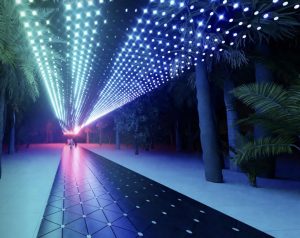
As such, dissolving threshold anxiety is one key way to make office spaces more compelling to visit, and more inclusive in the process. There are many ways to achieve this, but aesthetic considerations are always the simplest of starting points. Introducing foliage and greenery into the office, as part of a biophilic design scheme, can lower the cognitive load required by the brain o adjust to new environments), making the office feel like a cohesive, calming sanctuary rather than a series of disconnected boxes.
The Ergonomics of Visual Flow
Cognitive load is an important aspect to consider more generally when thinking about office design – not just from an attention-based perspective, but also from an inclusivity perspective. Small, busy patterns can create “visual noise” that contributes to sensory overload—a major factor in workplace burnout.
Quiet architecture, then, is key to allowing the mind to focus on deep work. In outdoor spaces, concrete doesn’t have to mean austere, anxiety-inducing hostility; concrete paving slabs are a neutral floor surface that minimises visual clutter, and makes for a more neuro-inclusive space accordingly. Inside, combining biophilic elements with neutral wall colours can make for a zen, stable space that doesn’t feel oppressively without personality.
Creating Third-Space Meeting Zones
If we acknowledge the workplace as a potentially oppressive environment, then we also acknowledge the potential of compartmentalisation to reduce that oppressive environment. In 2026, office micro-climates are crucial to managing workplace wellness. By creating specific areas designed for different tasks and even emotional states, it is possible to better regulate your workforce. Third-space meeting rooms can be utilised apart from conference rooms as informal environments to enable separation, socialisation and active recovery.