Dr Aadarsh Mishra Presents Viscoelastic Research in Aortic Biomechanics at Liverpool Conference
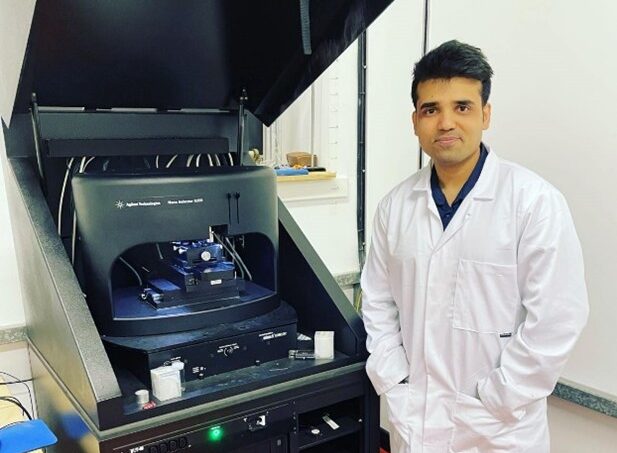
Dr. Aadarsh Mishra conducting viscoelastic experiments on agarose in the research lab
Dr Aadarsh Mishra, who holds a DPhil in Engineering Science from the University of Oxford, presented his research on the viscoelastic characterisation of porcine aortic tissue across macro- and micro-length scales at Liverpool’s “Aorta: Structure to Rupture 2026” conference.
Liverpool, UK – A mathematical framework capable of characterising the complex mechanical behaviour of the aortic wall has been presented at a cardiovascular conference in Liverpool. The research was presented by Dr Aadarsh Mishra at the Aorta: Structure to Rupture 2026 conference, bringing together leading scientists, engineers, and cardiovascular surgeons from across the UK.
The study applies fractional calculus to model the viscoelastic behaviour of the aorta and investigates its mechanical properties across macro- and micro-length scales. Fractional calculus extends the concept of classical derivatives and integrals to non-integer orders, providing a powerful mathematical framework for describing materials that exhibit memory and time-dependent behaviour. Such materials include biological tissues, polymers, and many complex natural systems.
Dr Aadarsh Mishra has long drawn inspiration from the work of the renowned Indian mathematician Srinivasa Ramanujan, as well as from the vision and scientific leadership of former Indian President and scientist Dr A.P.J. Abdul Kalam.
By applying fractional-order constitutive models to aortic tissue, the research aims to improve understanding of how the aorta responds to mechanical loading. Cardiovascular diseases remain one of the leading causes of mortality worldwide. Improved methods for assessing tissue integrity and disease progression have the potential to enhance patient stratification, support clinical decision-making, and ultimately save lives.
Presenting at a Leading International Conference
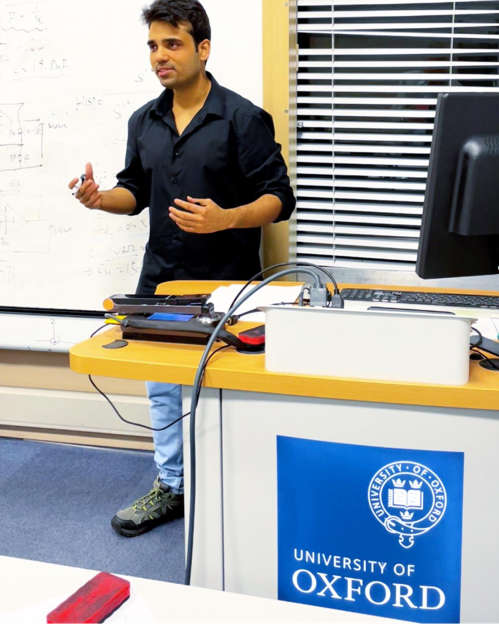
Dr Mishra presented the findings to an audience of internationally recognised researchers and consultant surgeons specialising in cardiovascular disease.
“It was a privilege to present this work in front of such a distinguished audience. The conference brought together experts from molecular medicine, imaging, and biomechanics, creating an ideal environment to discuss how advanced mathematical modelling can contribute to the understanding and diagnosis of aortic disease.”
— Dr Aadarsh Mishra
From Fractional Calculus to the Springpot Model
A central feature of the research is the use of the springpot, also known as the Scott–Blair element, which forms the foundation of many fractional viscoelastic models.
Unlike conventional mechanical models that represent tissues using only springs and dashpots, the springpot incorporates a fractional derivative that allows it to capture the gradual transition between purely elastic and purely viscous behaviour. This approach is particularly well suited to biological tissues, which exhibit complex relaxation behaviour across multiple timescales.
The springpot is characterised by a fractional order parameter, α, where:
- α = 0 corresponds to ideal elastic behaviour
- α = 1 corresponds to ideal viscous behaviour
Values between these limits capture the viscoelastic nature of soft tissues and provide insight into their internal microstructural organisation.
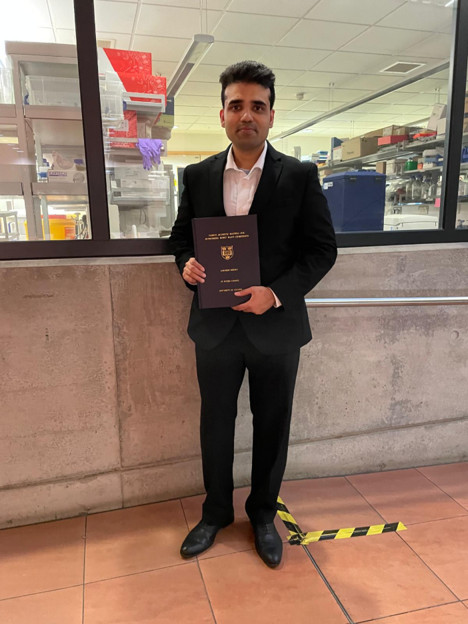
Dr Aadarsh Mishra was awarded a DPhil in Engineering Science from the University of Oxford for his doctoral research on passive acoustic mapping for monitoring burst wave lithotripsy.
Biomechanical testing of Porcine Aorta
The research utilised porcine aortic tissue and combined mechanical measurements across both macro- and micro-length scales. Using rheometry and oscillatory nanoindentation techniques, the study investigated how different regions of the aorta respond to mechanical loading across a range of frequencies.
Building a Unified Framework for Soft Tissue Biomechanics
Over the past several years, Dr Aadarsh Mishra has applied fractional viscoelastic models to a range of biological tissues and tissue-mimicking materials, including the porcine heart, kidney, liver, brain, and agarose-based phantoms.
Published studies have demonstrated that springpot-based fractional models consistently provide more accurate descriptions of frequency-dependent tissue behaviour than many classical integer-order viscoelastic models while requiring relatively few physically meaningful parameters.
Collectively, this body of work contributes toward a unified mathematical framework for interpreting elastography measurements, designing tissue-mimicking materials, and understanding the biomechanical behaviour of soft tissues across macro- and micro- length scales.
Selected publications related to fractional viscoelastic modelling include:
- Mishra, A., & Cleveland, R. O. (2024).
Rheological properties of porcine organs: measurements and fractional viscoelastic model.
Frontiers in Bioengineering and Biotechnology, 12, 1386955.
https://doi.org/10.3389/fbioe.2024.1386955 - Mishra, A., & Cleveland, R. O. (2024).
Agarose as a Tissue Mimic for the Porcine Heart, Kidney, and Liver: Measurements and a Springpot Model.
Bioengineering, 11(6), 589.
https://doi.org/10.3390/bioengineering11060589 - Mishra, A., & Cleveland, R. O. (2024).
Biomechanical Modelling of Porcine Kidney.
Bioengineering, 11(6), 537.
https://doi.org/10.3390/bioengineering11060537 - Mishra, A., Akhtar, R., & Cleveland, R. O. (2026).
Agarose as a tissue mimic for porcine kidney at the micro‑length scale.
Journal of the Mechanical Behavior of Biomedical Materials (Elsevier) , 176, 107332.
https://doi.org/10.1016/j.jmbbm.2026.107332
Together, these studies demonstrate the applicability of springpot-based fractional viscoelastic models across multiple organs and length scales, providing a unified framework for understanding soft tissue mechanics. Dr Mishra’s research has also been recognised by The British Society for Nanomedicine at the age of 27.
 Dr. Aadarsh Mishra graduated from the University of Oxford with a DPhil in Engineering Science
Academic Background
Dr Aadarsh Mishra was awarded a DPhil in Engineering Science from the University of Oxford at the age of 26 and a First Class Honours degree in Mechanical Engineering from Cardiff University at the age of 21.
His doctoral research focused on developing advanced monitoring techniques for burst wave lithotripsy, a non-invasive ultrasound therapy for kidney stone treatment. Using passive acoustic mapping and beamforming methods, he investigated cavitation activity to improve treatment safety and effectiveness.
His broader research interests span biomechanics, medical ultrasound, tissue viscoelasticity, computational modelling, and translational biomedical engineering.
His achievements include:
- Co-inventing an electrode shield technology that was subsequently filed as an international patent application at the age of 20.
- Co-authoring a publication in the journal Nano Letters at the age of 21
- Contributing to defence-related research projects at IIT Delhi at the age of 21
- Completing a research internship in tribology at the Indian Institute of Science (IISc), Bangalore at the age of 17
Dr Aadarsh Mishra was a member of St Peter’s College at the University of Oxford and has presented his research at international conferences.
 Future Clinical Applications
Future research may explore how fractional viscoelastic modelling can be integrated with medical imaging, elastography, computational biomechanics, and artificial intelligence to support future clinical applications.
Potential areas of impact include:
- Improved understanding of aortic tissue behaviour
- Improved interpretation of elastography measurements
As the field of cardiovascular biomechanics continues to evolve, fractional calculus offers a promising mathematical language for describing the complex behaviour of tissues.
“Mathematics allows us to uncover patterns that are otherwise invisible. By combining advanced mathematical modelling with experimental biomechanics, we hope to develop tools that help clinicians better understand disease progression and ultimately improve patient outcomes.”
— Dr Aadarsh Mishra
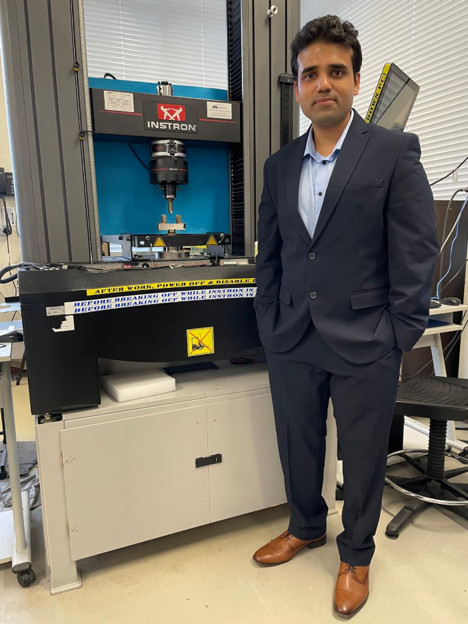 Dr Aadarsh Mishra’s research has included the viscoelastic testing and analysis of soft tissues such as the porcine kidney, heart, aorta, brain, and liver.