2026’s 8 Best HCM Systems for UK Businesses (Tested and Ranked)

One minute takeaway
- A strong HCM system should consolidate payroll, talent management, workforce planning, and employee engagement into one platform, so your HR team isn’t toggling between five different tools.
- UK-based organisations need HMRC-compliant payroll and IR35 handling baked in, not bolted on through third-party add-ons.
- The eight platforms on this list range from enterprise-grade suites to mid-market-focused options, and the right pick depends on your headcount and global footprint.
The shift toward unified HCM systems is accelerating
Gartner’s 2026 cloud HCM forecast shows organisations consolidating an average of 3.2 separate HR point solutions into single-platform suites. The trend makes sense: fragmented systems create data silos and frustrate employees who need to log into multiple portals for basic tasks like requesting time off or checking pay stubs.
For UK companies, the stakes are higher. HMRC compliance and IR35 contractor rules add layers of complexity that generic HR tools don’t handle well. Choosing the wrong HCM system means either overpaying for enterprise features your team won’t use or outgrowing a lightweight tool within 18 months.
This list evaluates eight HCM systems through a UK lens, focusing on global readiness, payroll compliance, and real-world user feedback from G2 and Capterra reviews.
Why choosing the right HCM system matters for UK organisations
An HCM system touches every employee interaction, from the offer letter to the exit interview. A poor fit ripples through the entire organisation. HR teams spend hours on manual workarounds. Managers lose visibility into headcount costs. Employees disengage from clunky self-service portals.
The cost of switching platforms mid-growth is steep, too. Migration projects consume six to twelve months and pull HR teams away from strategic work. Getting the initial selection right saves more than money; it protects your team’s capacity during the periods when you need it most.
Key considerations before selecting an HCM system
Workforce size and growth trajectory
A platform that serves a 50-person startup won’t handle a 500-person multi-entity business. Consider where your headcount will sit in three years, not where it sits today. Scalability gaps become visible fast once you open offices in new countries or acquire companies with different payroll cycles.
Talent management depth
Some HCM systems treat performance reviews and engagement surveys as afterthoughts. Others build entire talent suites around skills frameworks and calibration tools. If your organisation is investing in retention and internal mobility, talent depth should sit at the top of your criteria.
Analytics and reporting
Real-time dashboards that surface attrition risk and headcount costs drive better decisions than static quarterly reports. Look for platforms that let HR build custom reports without needing IT support.
Integration ecosystem
Your HCM system needs to connect with payroll providers, accounting software, and communication platforms like Slack or Microsoft Teams. Open APIs and pre-built connectors reduce implementation time.
UK-specific compliance
HMRC payroll filing, P60 generation, and IR35 contractor classification aren’t optional features for UK buyers. Platforms that treat UK compliance as a secondary market often lag behind on regulatory updates.
1. HiBob (Bob)
Best for: mid-sized UK organisations that need a configurable HCM platform up and running fast
Most enterprise HCM platforms measure implementation in quarters. Bob measures it in weeks. That speed comes from a configuration-first architecture: review cycles, approval flows, onboarding sequences, and hiring pipelines all adapt to each organisation’s structure through in-app settings rather than consultant-led workshops. Capterra reviewers (4.6/5 from 167+ reviews) cite this configurability as a primary reason they chose it over heavier alternatives. G2 reviewers (4.5/5 from 1,811+ reviews) reinforce the pattern, highlighting Bob’s consumer-grade interface and high adoption rates.
Key capabilities
For UK buyers, native payroll handles HMRC compliance, IR35 contractor classification, and P11D and P60 generation without third-party add-ons. The Payroll Hub extends coverage to additional countries through no-code integrations, so multinational teams manage all payroll cycles from one dashboard. Talent management covers performance reviews with 360-degree feedback and calibration, succession planning, and engagement surveys with AI sentiment analysis. Workforce planning adds headcount scenario modelling with Mercer benchmarking data for pay equity analysis.
Pricing: HiBob doesn’t publish rates. Modular pricing lets organisations pay for what they use, scaling with headcount.
What stood out: Implementation speed paired with genuine depth. Bob goes live faster than most competitors and still covers performance, payroll, compensation, and workforce planning in a single system.
Where Bob could improve: The lack of public pricing makes early-stage comparison harder. Organisations under 50 employees may find the full suite more than they need at that scale. Native payroll covers only the UK and US.
2. Personio
Best for: European SMBs looking for an HR and recruiting platform built around DACH compliance
Personio has built a strong presence in the German-speaking market and expanded across Europe. The platform covers core HR, recruiting, payroll preparation, and basic performance management. G2 reviewers (4.4/5 from 838 reviews) praise its clean interface and straightforward employee directory.
Key capabilities
Personio handles absence management and document storage alongside onboarding checklists and applicant tracking. The recruiting module supports multi-channel job posting, and the payroll preparation feature exports data to external payroll providers.
Pricing: Personio publishes tiered pricing (Core, Core Pro, and custom plans) based on employee count and selected modules.
What stood out: Setup is fast for European companies. The platform handles country-specific employment contracts and leave policies for multiple EU jurisdictions.
Where Personio could improve: The platform doesn’t offer native UK payroll, which means UK-based teams still need a third-party payroll provider. G2 reviewers report that the performance management module lacks the depth of dedicated talent platforms; features like 9-box calibration and succession planning are absent or limited. Several reviews also mention price increases at renewal that caught teams off guard.
3. Rippling
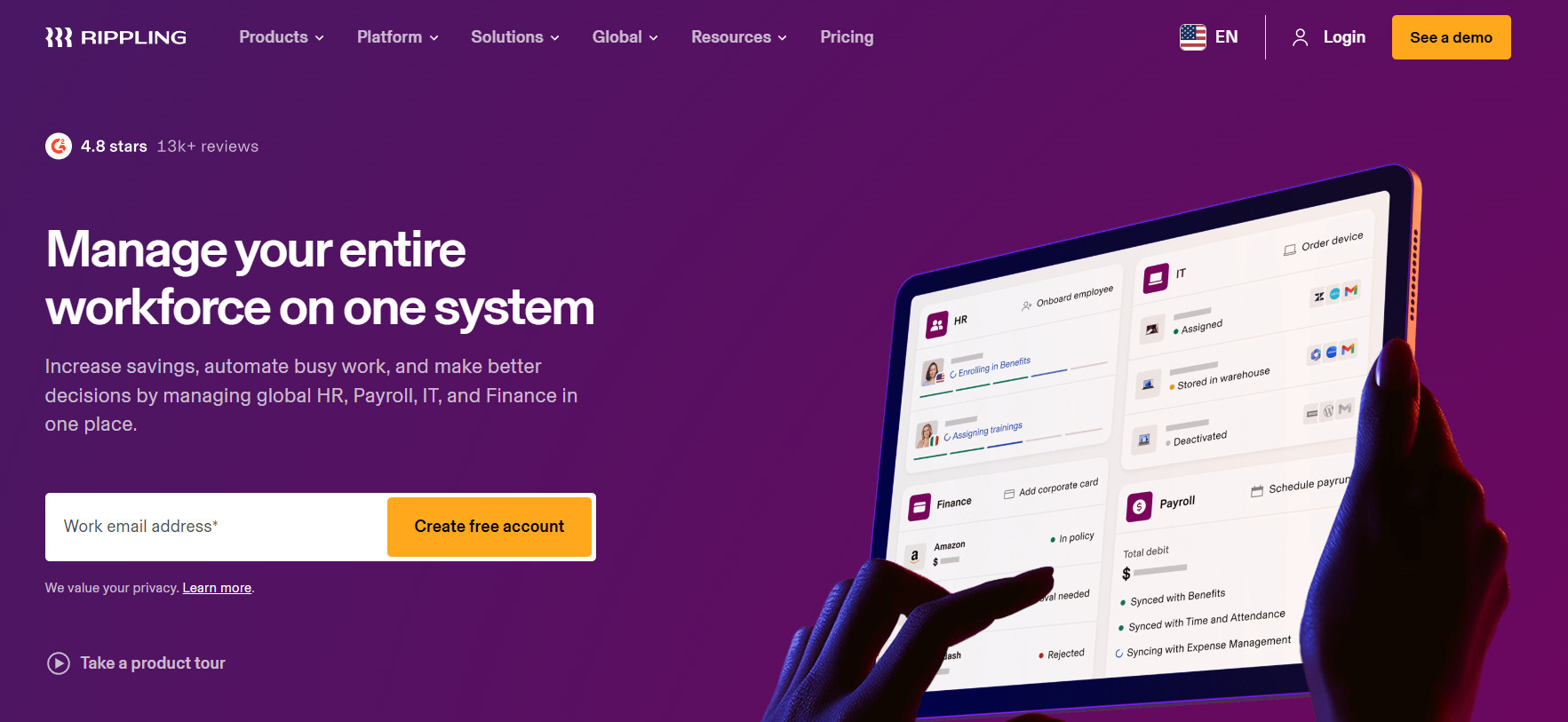
Best for: organisations that want to manage HR, IT, and finance from a single admin console
Rippling takes an unusual approach by combining HR and IT device management with spend management in one platform. The core value proposition centres on an employee graph that connects identity and payroll data to device records, so onboarding a new hire triggers laptop provisioning and app access alongside benefits enrolment.
Key capabilities
The HR Cloud covers payroll (US-focused) and benefits administration alongside time tracking. The IT Cloud handles device inventory and app provisioning. The Finance Cloud manages corporate cards and expense tracking.
Pricing: Rippling starts at $8 per user per month for the core platform, with additional modules priced on top. Total costs can escalate as organisations add IT and finance features.
What stood out: The cross-functional data model is unique. Offboarding an employee can revoke device access and disable SaaS accounts while processing the final pay run from one action.
Where Rippling could improve: G2 reviewers (4.8/5 from 12,635 reviews) give high marks overall, but recurring themes in negative reviews include US-centric default configurations that require manual adjustment for non-US entities. Several users report a steep learning curve during initial setup, and mobile app reviews highlight functionality gaps compared to the desktop experience. Pricing can escalate once an organisation adds multiple product clouds beyond the base HR layer.
4. Workday
Best for: Fortune 500 enterprises with complex global operations and deep pockets
Workday HCM serves large enterprises with a comprehensive suite covering HR and finance alongside planning. The platform holds a strong position in Gartner’s Magic Quadrant for Cloud HCM Suites and serves many of the world’s largest organisations.
Key capabilities
Workday provides workforce planning and compensation management with advanced analytics through Workday Prism Analytics. The platform also includes talent optimisation modules. The platform supports operations in over 200 countries with multi-currency and multi-language capabilities.
Pricing: Workday doesn’t publish pricing. Industry estimates place annual costs between $50 and $200+ per employee depending on modules, with significant implementation fees.
What stood out: Reporting depth is a strength. Workday’s analytics tools let finance and HR teams build sophisticated workforce cost models, and the platform’s single-codebase architecture means every customer runs the same version.
Where Workday could improve: G2 reviewers (4.1/5 from 1,613 reviews) note that the interface feels dated and unintuitive compared to modern platforms. Implementation requires dedicated consultants and can take 12 to 18 months. The platform’s complexity makes it impractical for organisations with fewer than 500 employees. Multiple reviewers describe the learning curve as significant, with ongoing admin tasks requiring specialised Workday training.
5. SAP SuccessFactors

Best for: large enterprises already running SAP infrastructure that want HCM integration with ERP
SAP SuccessFactors targets enterprise-scale organisations and provides coverage across 200+ countries. The platform integrates with SAP’s broader ERP ecosystem, making it a natural fit for companies with existing SAP investments.
Key capabilities
SuccessFactors includes modules for core HR and payroll alongside talent management and learning. Employee Central serves as the HR system of record, with data flowing into SAP’s finance and operations modules.
Pricing: SAP SuccessFactors pricing isn’t published and varies based on module selection and employee count. Licensing fees plus implementation costs place it in the enterprise pricing tier.
What stood out: The depth of global compliance coverage is extensive. SAP maintains country-specific payroll engines and regulatory updates for a long list of jurisdictions.
Where SAP SuccessFactors could improve: G2 reviewers (4.1/5 from about 1,500 reviews) describe a dated, complex user interface that frustrates daily users. Implementation requires SAP-certified consultants, and projects can stretch well beyond initial timelines. The platform is excessive for organisations under 1,000 employees, and SAP’s release cycle moves slower than cloud-native competitors. Several reviewers mention that navigating the module structure feels like learning a separate software discipline.
6. UKG Pro

Best for: large workforces with complex scheduling and time-tracking needs
UKG Pro (the platform once called UltiPro) targets mid-to-large organisations, with particular strength in workforce management and scheduling. The platform serves industries like healthcare and retail where shift-based scheduling is a core requirement.
Key capabilities
UKG Pro covers payroll and HR alongside workforce management tools for time tracking and scheduling. The scheduling engine handles complex shift patterns and labour cost forecasting.
Pricing: UKG doesn’t publish pricing. Costs depend on the module mix and employee count. Enterprise pricing with significant implementation investment is the norm.
What stood out: The workforce management suite is UKG’s differentiator. The scheduling and time-tracking tools handle nuanced shift rules and overtime calculations across multiple jurisdictions.
Where UKG Pro could improve: G2 reviewers (4.3/5 from 2,187 reviews) flag inconsistent usability across different modules; some areas feel polished while others feel outdated. Support quality receives mixed feedback, with 39 G2 mentions citing frustrating delays. Platform updates sometimes introduce friction for existing workflows, and the learning curve during initial implementation is steep, with 45 G2 mentions referencing difficulty during transition.
7. BambooHR
Best for: small to mid-sized US-based companies that need a clean, simple HR platform
BambooHR has earned a reputation for usability. The platform covers core HR, time tracking, and hiring with basic performance management with an interface that G2 reviewers (4.4/5 from 5,033 reviews) describe as intuitive and easy to learn.
Key capabilities
BambooHR handles employee records and PTO tracking alongside basic applicant tracking and employee satisfaction surveys (eNPS). The reporting module provides standard HR reports with some custom report options.
Pricing: BambooHR offers two tiers (Essentials and Advantage) with per-employee pricing. The company doesn’t publish exact rates, but reviewers report it as affordable for smaller teams.
What stood out: Ease of use dominates the reviews. G2 data shows 905 mentions praising BambooHR’s intuitive interface, making it one of the highest-rated platforms for user experience among SMB HR tools.
Where BambooHR could improve: The platform’s payroll is US-only, which disqualifies it for UK organisations that need native HMRC-compliant processing. G2 reviewers flag limited customisation (182 mentions) and restricted reporting capabilities (169 mentions) as recurring frustrations. Feature depth drops off for talent management tasks like calibration and succession planning. Organisations that grow past 200-300 employees often find BambooHR’s feature ceiling.
8. ADP Workforce Now
Best for: mid-market companies that prioritise payroll processing reliability and compliance breadth
ADP Workforce Now targets mid-sized organisations and bundles payroll with HR and benefits administration. ADP’s decades of payroll experience give it deep compliance coverage across US federal and state regulations.
Key capabilities
The platform handles payroll processing and tax filing alongside benefits administration and onboarding workflows. ADP’s compliance team monitors regulatory changes and pushes updates to the platform.
Pricing: ADP prices based on employee count and module selection. The company doesn’t publish rates, and quotes require contacting sales.
What stood out: Payroll reliability is ADP’s anchor. The company processes payroll for millions of employees across the world, and the compliance infrastructure is mature.
Where ADP could improve: G2 reviewers (4.2/5 from 4,209 reviews) surface two persistent complaints: poor customer support (111 mentions citing slow responses and inadequate assistance) and a clunky, unintuitive interface (98 mentions describing difficult navigation and outdated design). The platform offers limited customisation (71 mentions), and reviewers describe rigid workflows that don’t adapt well to non-standard processes. The interface hasn’t kept pace with modern HR platforms, and UK-specific payroll support lags behind ADP’s US capabilities.
How to pick the right HCM system for your UK team in 2026
Selecting an HCM platform requires matching the vendor’s strengths to your organisation’s actual needs, not aspirational ones. Enterprises with 1,000+ employees and global operations may gravitate toward Workday or SAP SuccessFactors despite the implementation overhead. Organisations that need scheduling sophistication should evaluate UKG Pro. Companies looking for a lightweight US-focused tool can start with BambooHR.
For mid-sized and growing UK organisations that need all-in-one coverage, modern UX, native UK payroll, embedded AI, and the flexibility to scale across borders, Bob from HiBob hits the balance between depth and usability that the enterprise-tier platforms sacrifice for breadth and the SMB tools sacrifice for simplicity.
Common questions about HCM systems
Does an HCM system handle HMRC payroll compliance?
Some platforms include native UK payroll with HMRC filing and IR35 support. Bob, for example, processes UK payroll through its native module with full HMRC compliance. Others require a third-party payroll provider and handle payroll preparation rather than processing.
Is an HCM system worth the investment for a company with 100 employees?
Yes, if the organisation is growing and plans to expand into new markets. A single HCM platform eliminates the cost of maintaining separate tools for HR and payroll. Bob’s modular architecture lets a 100-person company start with core HR and add suites as the team scales.
What employee experience tools should an HCM system include?
Look for self-service portals and mobile access alongside engagement surveys with sentiment analysis. Onboarding workflows that don’t require manual checklists matter, too. Recognition features and anonymous feedback channels add depth to the employee experience layer.
How do HCM platforms vary in their performance management approach?
Some platforms offer basic annual review templates. Others build performance around continuous feedback and calibration grids tied to skills-based evaluations. Bob’s Talent Suite connects performance reviews to succession planning and compensation decisions, creating a feedback loop rather than a standalone annual event.
Can an HCM system support both UK and international payroll?
Platforms vary. Some offer native payroll in one or two countries and rely on integrations for others. Bob provides native UK and US payroll plus a Payroll Hub that connects to local providers in additional markets, giving multinational teams a single dashboard for all payroll operations.
What role does AI play in modern HCM systems?
AI in HCM ranges from basic chatbots to embedded features across recruiting, performance, compensation, and workforce planning. Bob integrates AI into CV screening, review summaries, survey analysis, and compensation recommendations, each feature targeted at a specific HR workflow.
How long does a typical HCM implementation take?
Timelines range from weeks to over a year depending on the vendor and organisational complexity. Enterprise platforms like Workday and SAP SuccessFactors often require 12 to 18 months. Mid-market platforms like Bob complete most implementations in weeks, with phased rollouts for additional modules.


