Best Global HR & Payroll Platforms for Multinational Companies

A multinational with eight legal entities often ends up running eight versions of HR and payroll. One country sits with a local payroll bureau while another still lives in a spreadsheet. The HRIS stops at the border, so finance rekeys the same headcount into separate systems every month. That fragmentation is the problem the best global HR & payroll platforms for multinational companies are built to solve, by putting people data and pay on one system of record and consolidating the reporting across every entity. Buyers often search for the best global payroll software, but a group consolidating people operations needs more than a payroll bureau: it needs an HR core that the payroll hangs off.
This guide scores eight platforms on a published six-axis rubric, each axis weighted, so you can see where a vendor earns its place and re-rank the field on the priorities that matter to your business. The write-ups follow a reading order with the strongest all-in-one consolidation pick first, and every platform carries its full scorecard so you can weight the axes your own way.
How the best global HR and payroll platforms were scored
Every platform below is scored 1 to 5 on six axes, and each axis carries a fixed weight so the total reflects what a consolidating multinational values most. Scores are an editorial synthesis of each vendor’s published product and pricing pages and its G2 review record, checked in 2026. There is no hands-on payroll run behind the numbers; where a figure comes from a review outlet or a vendor page, that is what it is.
The six axes and their weights:
- Consolidation and reporting across entities (22%): whether people data and pay sit on one record, and whether finance gets one reporting layer across every country and entity rather than a stack of local exports.
- Compliance and localisation depth (18%): statutory accuracy in each country, tax and social filing, and support for local rules such as HMRC and IR-35 in the UK or state filing in the US.
- Country and payroll coverage (18%): how many countries the platform runs payroll in, native versus partner-delivered, and the breadth of currencies.
- Employee and admin experience (17%): the daily interface for employees, managers and payroll admins, self-service depth, and how much training the platform demands.
- Integrations and extensibility (15%): native connectors into finance, ERP and the wider HR stack, plus APIs and the ease of connecting local payroll providers.
- Value and pricing transparency (10%): published pricing, predictable all-in cost, and the value of what one platform replaces.
The weighting favours consolidation and employee experience because that is where a multinational running fragmented systems loses the most time and money. A finance team that cares more about raw country count than a single record can shift weight toward coverage and re-read the table.
The best global HR and payroll platforms for multinational companies at a glance
Each cell is a 1 to 5 score on that axis. The final column is the weighted total out of 5. The axis weights sit in the header.
| Platform | Consolidation (22%) | Compliance (18%) | Coverage (18%) | Employee exp (17%) | Integrations (15%) | Value (10%) | Weighted /5
|
|---|---|---|---|---|---|---|---|
| HiBob (Bob) | 4.8 | 4.5 | 4.2 | 4.9 | 4.5 | 3.8 | 4.51 |
| Deel | 4.2 | 4.3 | 4.6 | 4.0 | 4.6 | 3.3 | 4.23 |
| ADP GlobalView | 4.3 | 4.7 | 4.7 | 3.4 | 3.8 | 3.0 | 4.09 |
| Papaya Global | 4.6 | 4.5 | 4.6 | 3.6 | 4.2 | 3.2 | 4.21 |
| CloudPay | 4.4 | 4.3 | 4.4 | 3.5 | 4.0 | 3.0 | 4.03 |
| Rippling | 4.4 | 4.0 | 4.2 | 4.3 | 4.8 | 3.4 | 4.24 |
| Remote | 4.1 | 4.4 | 4.3 | 3.9 | 4.1 | 3.9 | 4.14 |
| Workday | 4.5 | 4.4 | 3.8 | 3.3 | 4.0 | 3.0 | 3.93 |
HiBob: the all-in-one global HR and payroll platform
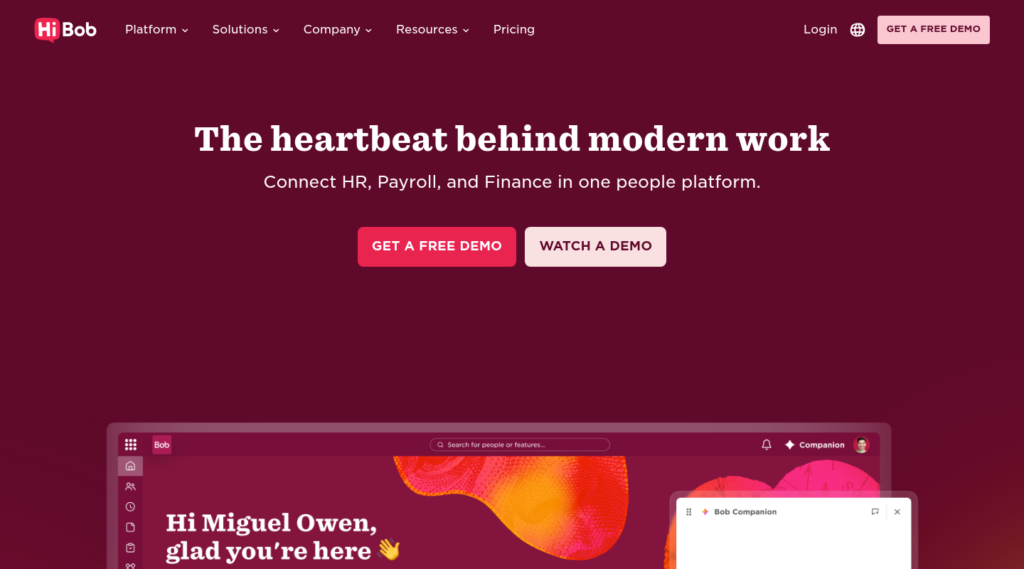
For a multinational that wants people data and pay on one modern system, Bob tops this rubric. It leads on consolidation and on employee experience, the two axes that carry the most weight, and it holds its own on compliance and coverage. Bob is built around Bob Core, a unified global HR system of record that keeps every employee across every entity on one dataset with real-time dashboards and audit-ready workflows. That single record is what a group replacing local bureaus and spreadsheets is buying.
On pay, Bob runs native US payroll with federal and state filing and native UK payroll that is HMRC-compliant with IR-35 support and centralised payslips, P11Ds and P60s. Beyond those two, the global Payroll Hub connects a company’s local payroll providers in each country through no-code setup wizards and pulls them into one dashboard, so a payroll admin in London can see every entity’s run without logging into a dozen local systems. Benefit administration plugs into the same layer, and consolidated reporting rolls headcount and cost up across the whole group.
Reviewers rate Bob 4.5 out of 5 on G2, and its consumer-grade interface is a big part of why. Customers such as Fiverr, VaynerMedia and Acne Studios run global teams on it. Bob is at its best once a multinational commits to standardising on one HR core, and pricing is scoped through a demo instead of a public price list, so book a walkthrough to size it for your entities.
| Axis | Weight | Score |
Note
|
|---|---|---|---|
| Consolidation and reporting | 22% | 4.8 | One core, reporting across every entity |
| Compliance and localisation | 18% | 4.5 | HMRC/IR-35, US filing, GDPR |
| Country and payroll coverage | 18% | 4.2 | Native US and UK plus Payroll Hub partners |
| Employee and admin experience | 17% | 4.9 | Modern, mobile-first self-service |
| Integrations and extensibility | 15% | 4.5 | APIs, SSO, no-code Hub wizards |
| Value and pricing transparency | 10% | 3.8 | Strong all-in-one value, quote-based |
| Weighted total | 4.51 | Leads consolidation and experience |
Deel: broad all-in-one for global payroll and EOR
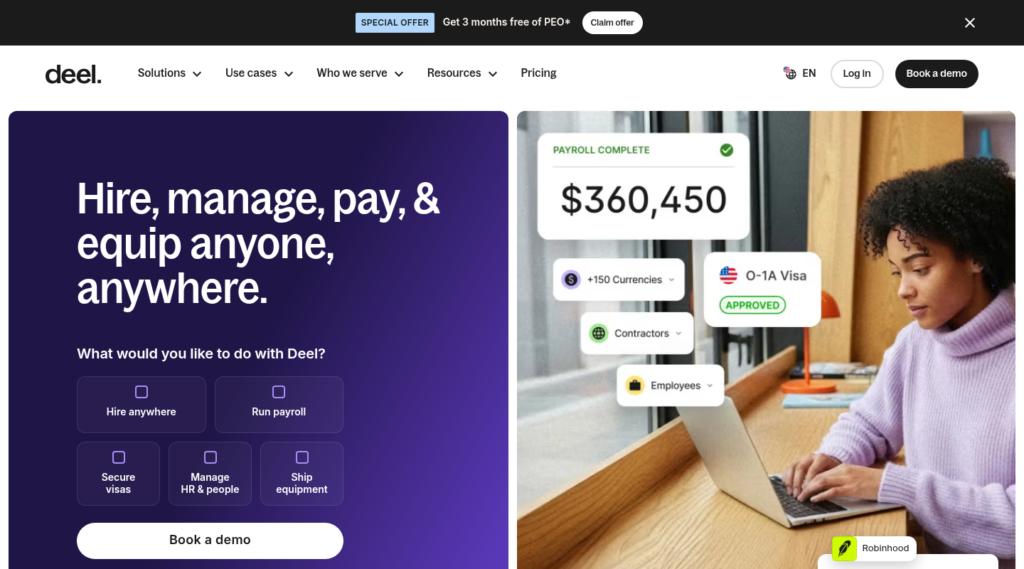
Deel is the widest single-vendor platform in the category, covering global payroll, employer of record, contractor management and HR on one self-serve product. It reaches 150-plus countries with full legal employment in 130-plus, and it carries one of the broadest native integration catalogues here, which is why it scores well on coverage and integrations. For a buyer who wants one dashboard for pay and contractors, it is a strong shortlist entry.
The trade-offs sit in cost and reliability. Deel holds a 4.7 out of 5 rating from 6,500-plus G2 reviews, though the recurring complaints in that record are payment issues, price (users tag it expensive) and processing delays, alongside slow loading times on the platform. Deel does not publish its FX terms, so the cost of converting salary into local currency is built into the rate rather than itemised. Base EOR pricing starts around $599 per employee per month. Model the FX on real salary volumes before comparing it with a flat-fee rival.
| Axis | Weight | Score | Note
|
|---|---|---|---|
| Consolidation and reporting | 22% | 4.2 | One dashboard for pay and contractors |
| Compliance and localisation | 18% | 4.3 | Mature classification and IP tooling |
| Country and payroll coverage | 18% | 4.6 | 150+ reach, legal employment in 130+ |
| Employee and admin experience | 17% | 4.0 | Broad, but slow loading reported |
| Integrations and extensibility | 15% | 4.6 | One of the broadest catalogues |
| Value and pricing transparency | 10% | 3.3 | From $599; FX terms not published |
| Weighted total | 4.23 | Coverage and integrations carry it |
ADP GlobalView: enterprise multi-country payroll at scale
On pure multi-country payroll, ADP has the longest track record on this list. ADP Global Payroll, built from GlobalView and Celergo, spans 140-plus countries and territories, backed by more than 3,000 in-house payroll and compliance professionals watching statutory change. For a large group that already runs ADP, extending to global payroll keeps everything under one long-trusted vendor, which is why it tops the coverage and compliance axes.
The cost is experience and price. ADP holds a 4.2 out of 5 rating from 4,200-plus G2 reviews, where reviewers flag poor customer support access, missing features and difficult navigation. Industry roundups describe the platform’s technology as dated and its onboarding as long and complex. ADP publishes no per-employee price, so a like-for-like comparison takes a sales call, and Forrester-cited figures put GlobalView implementation in the hundreds of thousands per country for large deployments. It suits a finance team that values incumbent scale over a modern interface.
| Axis | Weight | Score | Note
|
|---|---|---|---|
| Consolidation and reporting | 22% | 4.3 | Global reporting and analytics |
| Compliance and localisation | 18% | 4.7 | 3,000+ compliance staff, 140+ countries |
| Country and payroll coverage | 18% | 4.7 | 140+ countries and territories |
| Employee and admin experience | 17% | 3.4 | Dated interface, harder navigation |
| Integrations and extensibility | 15% | 3.8 | Pre-built HCM connectors, no count published |
| Value and pricing transparency | 10% | 3.0 | Quote-only, high implementation cost |
| Weighted total | 4.09 | Scale and compliance, not experience |
Papaya Global: finance-grade payroll consolidation
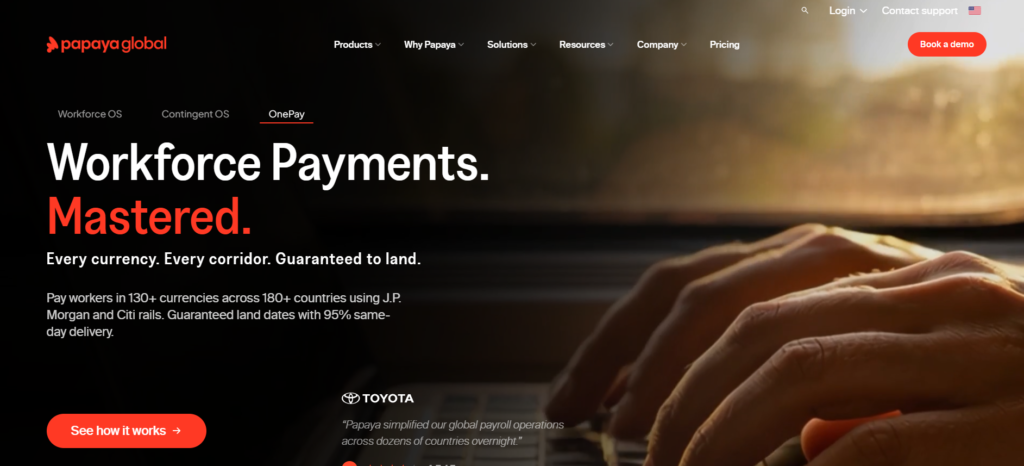
Papaya Global is the payroll-at-scale platform for finance-led buyers. It reaches 160-plus countries with 130-plus payment currencies and adds a licensed payments arm, so a finance team unifying payroll it already runs through several local vendors gets one reporting layer and audit trails built in rather than assembled after the fact. That reporting depth earns it strong consolidation and coverage scores.
The reservations are complexity and cost. Papaya carries a 4.5 out of 5 rating from a thin base of about 55 G2 reviews, and the documented downsides are poor customer support, invoicing problems and payment delays, with the platform’s own comparison noting it can be heavy for smaller teams and carry a learning curve. EOR pricing starts around $499 per employee per month, an FX processing fee applies with no published percentage, and the payments wallet must be pre-funded. Price the full stack rather than the headline.
| Axis | Weight | Score | Note
|
|---|---|---|---|
| Consolidation and reporting | 22% | 4.6 | Finance-grade multi-country reporting |
| Compliance and localisation | 18% | 4.5 | AI compliance engine, deep cert stack |
| Country and payroll coverage | 18% | 4.6 | 160+ countries, 130+ pay currencies |
| Employee and admin experience | 17% | 3.6 | Powerful, with a learning curve |
| Integrations and extensibility | 15% | 4.2 | HCM, ERP and finance connectors |
| Value and pricing transparency | 10% | 3.2 | From $499; invoicing issues reported |
| Weighted total | 4.21 | Consolidation at enterprise scale |
CloudPay: unified global payroll and treasury
 CloudPay runs multi-country payroll and treasury through one cloud platform across around 130 countries, with global payroll analytics and access to in-house payroll experts. For a company that wants payroll and payment funding on one system with a single reporting view, it is a credible consolidation pick, which shows in its consolidation and coverage scores.
The caveats come from how the service is delivered. Industry roundups note CloudPay has no shareable knowledge base, that larger and more complex projects can take time to implement, and that it outsources payment processing, which leaves clients with less direct control and visibility over the final leg. CloudPay does not disclose pricing: contracts carry a per-employee monthly licence fee, a per-payslip country fee, a one-off implementation fee and an initial fixed term of three to five years. That commitment suits a settled enterprise rather than a fast-changing footprint.
| Axis | Weight | Score | Note
|
|---|---|---|---|
| Consolidation and reporting | 22% | 4.4 | Unified payroll and treasury reporting |
| Compliance and localisation | 18% | 4.3 | One cloud across ~130 countries |
| Country and payroll coverage | 18% | 4.4 | Around 130 countries |
| Employee and admin experience | 17% | 3.5 | No shareable knowledge base |
| Integrations and extensibility | 15% | 4.0 | Strong integration capabilities |
| Value and pricing transparency | 10% | 3.0 | Quote-only, three to five year term |
| Weighted total | 4.03 | Solid consolidation, long commitment |
Rippling: HR, IT and payroll on one graph

Rippling is the platform-led pick, and it leads the integrations axis outright. It keeps every employee on one graph, publishes 600-plus integrations plus a real API, and localises its HRIS for 85-plus countries, with contractor payments reaching 185-plus. For a company standardising HR, IT and payroll on one tool, payroll riding the same record removes a lot of reconciliation.
The limits are depth and cost layering. Rippling holds a 4.8 out of 5 rating from 12,000-plus G2 reviews, but the recurring tags are feature gaps, a demanding learning curve and limited features on some modules, and outside roundups note lighter international compliance guidance than the payroll incumbents. Rippling does not publish EOR pricing on its primary pages, and a base HR-platform fee sits on top of the per-employee charge, so get the all-in monthly number in writing before you compare.
| Axis | Weight | Score | Note
|
|---|---|---|---|
| Consolidation and reporting | 22% | 4.4 | Payroll on one employee graph |
| Compliance and localisation | 18% | 4.0 | Lighter international compliance guidance |
| Country and payroll coverage | 18% | 4.2 | Payroll 85+, contractor 185+ |
| Employee and admin experience | 17% | 4.3 | Modern, but a steep learning curve |
| Integrations and extensibility | 15% | 4.8 | 600+ integrations plus an API |
| Value and pricing transparency | 10% | 3.4 | Base platform fee on top |
| Weighted total | 4.24 | Deepest platform surface here |
Remote: product-led global payroll and EOR
Remote is the product-led choice for a team that wants owned entities in its core markets and a clean self-serve experience. It markets a 100%-owned entity network across 90-plus core EOR countries, extends to 190-plus locations through partners, and runs a mature benefits and IP product alongside a distinct global payroll product for teams paying through their own entities. It also publishes pricing in full, which lifts its value score above most of the field.
The friction is support and reach. Remote carries a 4.5 out of 5 rating from 4,800-plus G2 reviews, where reviewers flag poor customer support, delays, missing features and payment issues, and roundups note support runs through a ticketing queue that can feel slow. EOR pricing starts at $699 per employee per month, and its owned-entity story applies to the core countries, so confirm which of your markets are owned versus partner-served.
| Axis | Weight | Score | Note
|
|---|---|---|---|
| Consolidation and reporting | 22% | 4.1 | Payroll for owned entities |
| Compliance and localisation | 18% | 4.4 | Owned entities, in-house legal and tax |
| Country and payroll coverage | 18% | 4.3 | 90+ owned, 190+ locations |
| Employee and admin experience | 17% | 3.9 | Polished, but ticket-based support |
| Integrations and extensibility | 15% | 4.1 | Solid across HRIS and finance |
| Value and pricing transparency | 10% | 3.9 | Published pricing from $699 |
| Weighted total | 4.14 | Product polish, owned core markets |
Workday: enterprise HCM with global payroll reach
Workday is the enterprise HCM incumbent, built for the largest and most complex organisations. It combines payroll, HR, talent and workforce management on one data model, which gives finance a powerful unified reporting layer and earns it the highest compliance-adjacent governance marks among the platform-led names. For a global enterprise already standardised on Workday, extending into payroll keeps reporting consistent.
The barriers are complexity and coverage. Workday holds a 4.1 out of 5 rating from 1,600-plus G2 reviews, where the documented complaints are poor interface design, a steep learning curve, limited customisation and difficult navigation. Native Workday payroll runs in a smaller set of countries, so wider global payroll leans on partners and add-on modules, which pulls down its coverage score against the dedicated payroll specialists. Pricing is quote-only and pitched at enterprise scale, and implementation timelines run long.
| Axis | Weight | Score | Note
|
|---|---|---|---|
| Consolidation and reporting | 22% | 4.5 | One HCM data model |
| Compliance and localisation | 18% | 4.4 | Enterprise-grade governance |
| Country and payroll coverage | 18% | 3.8 | Native payroll in fewer countries |
| Employee and admin experience | 17% | 3.3 | Powerful, but harder navigation |
| Integrations and extensibility | 15% | 4.0 | Enterprise connectors |
| Value and pricing transparency | 10% | 3.0 | Enterprise cost, quote-only |
| Weighted total | 3.93 | Deep reporting, heavy to run |
Which global HR and payroll platform fits your multinational
There is no single winner across every priority, which is the point of a weighted rubric: the right pick depends on what your entity model and your team value most. ADP GlobalView, Papaya Global and CloudPay lead on raw multi-country payroll reach for a finance team consolidating dozens of territories. Deel, Rippling and Remote lead on self-serve platform breadth for a company that wants payroll, contractors and EOR in one product. Workday suits the largest enterprises already standardised on its data model.
For a multinational running fragmented HR and payroll across countries, though, the axes that carry the most weight are consolidation and employee experience, and that is where Bob earns the top spot on this scorecard. Among the best global HR & payroll platforms for multinational companies, it is the one that puts a modern global HR core, native US and UK payroll, a Payroll Hub that connects local providers in-country, and consolidated reporting on a single system people want to use. If your goal is one record for people and pay across every entity, start your shortlist there and weight the rubric to match your countries.
Multinational HR and payroll: questions answered
What is the best global HR and payroll platform for multinational companies?
It depends on how your entities are set up and where your pain is sharpest. For a multinational consolidating fragmented systems, the platform that unifies people data and pay on one system of record tends to win, because the saving is in the reporting and rekeying it removes. Bob scores highest on this rubric for that reason: it pairs a modern global HR core with native US and UK payroll and a Payroll Hub that connects local providers in each country under one dashboard, so HR and payroll sit on one record and reporting rolls up across every entity. If raw country count is the single priority, ADP GlobalView and Papaya Global run payroll in more territories through their own network. Weigh coverage against consolidation before you shortlist.
What are the top global payroll providers in 2026?
The field splits by what you are buying. For payroll at enterprise scale, ADP GlobalView, Papaya Global and CloudPay run multi-country payroll across large territory counts. For an all-in-one platform that pairs payroll with contractors and EOR, Deel, Rippling and Remote lead on self-serve. For a unified HR core with connected global payroll, Bob leads this list, and Workday serves the largest enterprises already on its data model. The right shortlist is the two or three that match your entity model, not the longest brand roster.
EOR vs global payroll: what’s the difference?
Global payroll runs pay for people you already employ, through your own legal entities. It calculates gross to net, produces compliant payslips, remits income tax and social contributions in each country, and pays staff in local currency. An employer of record (EOR) becomes the legal employer in a market where you hold no legal entity, so it lets you hire there before you set one up, with payroll as one part of the service. Many multinationals run both: an EOR for new markets they are testing, and consolidated global payroll for the entities they already own. The question to settle first is whether you own an entity in each country you pay people in, because that decides which tool you need.