Business Class or Private Flights? The Cost of Lost Hours
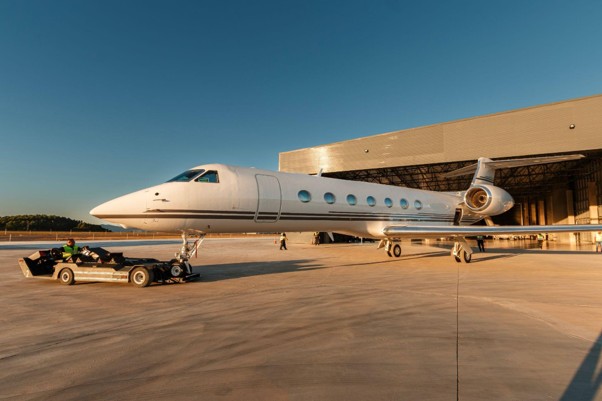
For many firms across Kent, Surrey, Hampshire and Essex, the question of how senior staff should fly abroad is no longer settled by the price of a ticket alone. A recent GBTA poll found that 45% of travel managers in Europe, the Middle East and Africa had seen premium economy bookings rise, while around a third of buyers globally reported fewer day trips, with longer and multi-stop journeys taking their place.
As trips grow longer and more complex, a broader calculation has become a consideration. Finance teams in the region are now comparing business class seats with chartered flights by asking what a journey really costs once the hours spent getting there and back are added to the bill.
Putting a Price on Time Away From the Desk
Transport economists have long attached a monetary value to time spent travelling for work. The EUROCONTROL standard inputs used in aviation cost-benefit studies, which draw on UK Airports Commission research, put the time of a UK business air passenger at €79.50 an hour at 2025 prices. That figure applies to one person, so the total climbs quickly once a director and two colleagues are travelling together.
Group size is where the sums start to compound. Each member of a team flying business class carries a separate fare as well as a separate door-to-door journey, and every hour of it is counted once per person. When the same team shares a private jet, the aircraft is priced as a whole and departs when the meeting schedule requires, so any hours saved apply to every seat at once.
Whether that saving is large enough to matter depends less on the cabin itself and more on the shape of the trip.
Matching the Cabin to the Journey
On long-haul routes, business class is a strong fit for an executive travelling alone. A lie-flat seat on an overnight flight to New York or Singapore allows a good night’s sleep before a full day of meetings, and a per-seat fare is straightforward to set against a departmental travel budget.
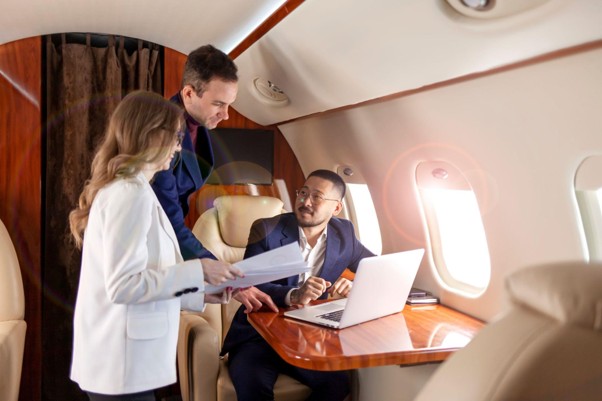
Private flights tend to be best on shorter itineraries that pack a lot of events in different places into a single day. A team visiting a supplier in northern Italy and a customer in southern Germany can fly directly between the airports closest to each site and be home the same evening. This avoids the extra hotel nights a two-day trip would otherwise involve. Because the cabin is reserved for the team alone, the flight itself also becomes usable working time, with room to review documents and talk through sensitive matters before landing.
Business Aviation Gateways on the South East’s Doorstep
For firms in the South East, how practical that second option proves often comes down to how close the nearest business aviation airport sits to the office. The region is well served on this front. Farnborough Airport in Hampshire was redeveloped specifically for business aviation and describes itself as the only dedicated business aviation airport in the UK. That gives companies along the M3 corridor a departure point built around corporate travellers.
On the edge of Kent, London Biggin Hill sits 15 miles from central London and operates without runway slots, according to the airport. Further east in Essex, the jet centre at London Southend Airport is open from 6am to 1:30am all year. Those hours suit an early departure for a morning meeting on the continent and a late return the same night.
With facilities this close to home, the decision shifts away from whether private flying is accessible and towards what each option needs to deliver for a particular trip.
Building a Fair Comparison Before Booking
A sensible starting point is to cost the whole journey for everyone travelling rather than the fare for a single seat. That means counting the hours from leaving the office to arriving at the meeting, along with any overnight stays the itinerary would require.
The number of travellers usually has the biggest influence on the result. A solo trip to one long-haul destination will often favour a business class seat on cost per person. A group visiting more than one site in a day, on the other hand, can narrow the gap considerably once lost hours and accommodation are included.
Firms that travel this way regularly may find it useful to ask a charter broker to set out the aircraft sizes and suitable airports for a given route, so the figures can be compared on equal terms. Agreeing in advance which kinds of trip suit which option also helps, as it allows decisions to be made on a consistent basis rather than in a rush before each booking.
Why the Hours Count as Much as the Fare
For firms in the South East region, the choice between business class and private flying is rarely about which is better in general. Business class serves the long-haul solo traveller well, while private flights come into their own when a team needs to cover more ground in less time.
Weighing both against the true cost of hours away from the desk gives a clearer answer than the ticket price alone. With dedicated business aviation airports close by, South East companies are well placed to make that comparison on their own terms.
Images:
Shutterstock ID 2680827911
Shutterstock ID 2390271933


