Best HR and Payroll Software for UK Employers (2026)

Quick verdict: After assessing ten platforms against the test that decides most UK buying decisions, whether one system holds your people records and runs HMRC-recognised payroll without a second tool bolted on, HiBob (Bob) is the best combined HR and payroll software for UK employers in 2026. It pairs native, HMRC-recognised UK payroll (RTI submissions, PAYE, NI, pension auto-enrolment, SSP and P60/P45 documents) with an all-in-one people platform covering hiring, onboarding, performance, compensation, engagement and workforce planning, and it keeps scaling with you, from growing SME to mid-market to enterprise. The nine alternatives below each earn their place, and this ranking explains who every one of them fits.
Choosing the best payroll software UK employers can trust turns less on feature counts than on one question: does the system file Real Time Information to HMRC without error on every pay run, or does it hand that job, out of sight, to a separate tool you reconcile each month? I’ve filed a Full Payment Submission late once, paid the penalty, and never repeated the mistake. I’ve set up pension auto-enrolment by hand and checked the contributions against a spreadsheet, and I’ve watched a smart-looking HR platform stumble the first time it met statutory sick pay. That experience shapes how I judge HR and payroll software, because in Britain the two words only belong together when a single platform keeps your employee data and runs PAYE, National Insurance and auto-enrolment as part of the same job.
That’s also where this market splits. Some roundups still file Bob under “dedicated HR you pair with payroll,” which gets it wrong: Bob runs native, HMRC-recognised UK payroll inside the platform. The comparison table below carries an explicit native-HMRC-payroll column, so you can see the real divide at a glance between the platforms that run UK payroll themselves and the HR tools that pass it to a partner.
What native UK payroll means (and why it splits this list)
A platform with native UK payroll calculates, files and documents your payroll inside its own engine. A platform that integrates for payroll stores your people records and sends the pay data to a separate provider that does the HMRC work. Both are legitimate designs, but they aren’t the same purchase, and the difference is the whole point.
A tool earns “native UK payroll” here only if it clears the compliance checklist every British employer lives by:
- HMRC recognition and RTI: the engine is recognised by HMRC and submits Real Time Information, meaning a Full Payment Submission (FPS) on or before each payday and an Employer Payment Summary (EPS) where it applies.
- PAYE and National Insurance: correct tax codes and NI categories every run, with P60, P45 and P11D documents produced from the same records.
- Pension auto-enrolment: assessment, enrolment and re-enrolment to The Pensions Regulator’s rules, with contributions calculated and filed rather than tracked by hand.
- Statutory pay and leave: statutory sick pay (SSP), maternity, paternity and shared parental pay, and holiday accrual under the Working Time Regulations, calculated to the penny for part-time and irregular-hours staff. The Employment Rights Act reforms to SSP (including removal of the lower earnings limit and making SSP payable from the first day of sickness) and paternity/unpaid parental leave day-one entitlements, which took effect in April 2026, are built into the engine, ahead of further phased changes such as the reduction of the unfair dismissal qualifying period to six months and new fire and rehire rules coming in January 2027, and mandatory payrolling of benefits in kind beginning at the start of the 2027/28 tax year (6 April 2027).
- Right-to-work and data protection: right-to-work checks held against the record, and UK GDPR compliance with data residency in UK or EU data centres.
Keep that list beside every demo. Several well-known HR platforms handle the records with polish and then pass PAYE and auto-enrolment to a partner tool, which is fine provided you know you’re buying two systems rather than one. The ranking marks which platforms run native payroll, which run it as a managed service, and which integrate for it.
How I evaluated the best payroll software UK employers can trust
I assessed each platform the way a UK buyer should, with the compliance checklist above in one hand and a real pay run in mind rather than a feature sheet. Having run UK payroll and set up auto-enrolment hands-on, I weighted the scoring towards the parts that break at month-end, not the ones that demo well.
The weighting stayed consistent across all ten platforms: native UK payroll and HMRC compliance, covering RTI submissions, PAYE, National Insurance, auto-enrolment and statutory pay (35%); breadth as a people system of record and all-in-one HR coverage (20%); the day-to-day experience for HR teams, line managers and employees (15%); reporting and people analytics (15%); configurability, automation and time to value (10%); and pricing transparency (5%). I checked pricing against provider and publisher sources in October 2026, drew ratings from G2 and Capterra where a credible UK review base exists, and flagged where a review base is thin or pricing is quote-only. Where a vendor only quotes, the entry says as much rather than guess, and every limitation below describes a documented product boundary, not a customer complaint.
Compare the best payroll software UK at a glance
This is the decision in one view. Read the native-HMRC-payroll column first: it separates the platforms that run UK payroll themselves from the payroll-only specialists and the HR tools that pass payroll to a partner.
| Platform | Best for | Starting price | Free trial | Native HMRC payroll | Rating
|
|---|---|---|---|---|---|
| HiBob (Bob) | Combined HR and native UK payroll that scales SME to enterprise | Bespoke quote | No (demo-led) | Yes (native UK and US; partners elsewhere) | G2 4.5/5 (2,697 reviews) |
| Sage | SMEs wanting a trusted, HMRC-recognised payroll name | Sage HR from £5.00/employee/mo; payroll by band | Yes | Yes (Sage Payroll) | 4.3/5 on G2 (92 reviews) |
| Employment Hero | SMEs wanting HR, payroll and benefits bundled | ~£4/employee/mo (minimum spend applies) | No (demo-led) | Yes (RTI, auto-enrolment) | 4.4/5 on G2 (4,331 reviews) |
| Access PeopleHR | Growing UK teams wanting HR and payroll from one group | By quote | No (demo-led) | Yes (Access Group UK payroll) | 4/5 on G2 (486 reviews) |
| Ciphr | Mid-to-large UK employers needing compliance depth | By quote | No (demo-led) | Yes (Ciphr Payroll) | 3.7/5 on G2 (6 reviews) |
| PayFit | SMEs wanting managed UK payroll with light HR | Per-employee monthly, by quote | No (demo-led) | Yes (managed UK payroll) | 4/5 on G2 (24 reviews) |
| BrightPay | Accountants, bureaus and small employers running payroll | Per-employer annual licence | Yes (free trial) | Yes, payroll only (no core HR) | 4.6/5 on G2 (28 reviews) |
| Moorepay | Employers wanting outsourced, managed UK payroll | By quote | No (demo-led) | Yes, managed (HMRC-recognised bureau) | 4.1/5 on G2 (39 reviews) |
| BambooHR | US-headquartered teams wanting a clean core HRIS | Published in USD; UK quoted | Yes (free trial) | No (US-built; UK payroll via partners) | 4.4/5 on G2 (7,164 reviews) |
| Breathe | Very small UK teams wanting simple HR admin | Flat monthly tiers by team-size band | Yes (free trial) | No (HR-only; no payroll) | 4.4/5 on G2 (608 reviews) |
Pricing checked against provider and publisher sources in October 2026. HiBob, Access PeopleHR, Ciphr, PayFit and Moorepay quote by requirement rather than publishing a figure. BambooHR lists its plans in US dollars and quotes UK buyers, so no sterling figure is shown.
Detailed reviews of the best HR and payroll software for the UK
1. HiBob (Bob), editor’s pick
 Why we picked HiBob
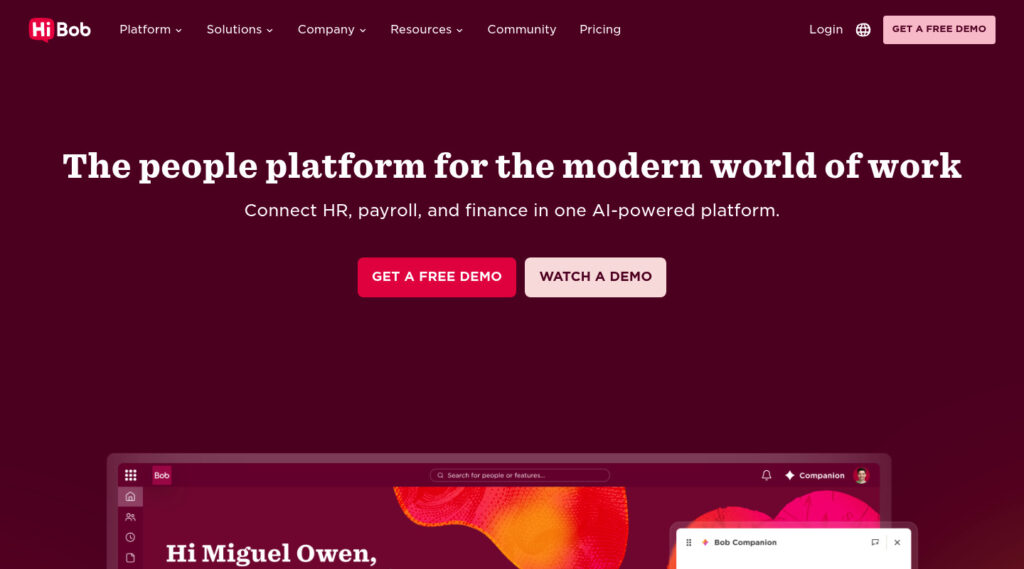
HiBob (Bob) tops this ranking because it does the whole job in one place rather than handing half of it to a second tool. Bob is a people platform built as one system: the core HR record, native UK payroll, hiring through its own applicant tracking system, onboarding, performance, compensation, engagement and workforce planning on one connected record, and that is how it replaces the stack of point solutions most UK teams stitch together. Native, HMRC-recognised UK payroll runs inside that platform, so it belongs in the combined HR and payroll category, not in the “pair it with payroll” bucket where some roundups still file it.
Pros
- Native, HMRC-recognised UK payroll (RTI submissions, PAYE, National Insurance, auto-enrolment, SSP, P60/P45) run inside the same system as core HR.
- One platform for HR, payroll, hiring, onboarding, performance, compensation, engagement and workforce planning, replacing several separate tools.
- Scales from a growing SME to the mid-market and further, into enterprise and multi-entity operations, without a painful re-platform.
- Automation carries the repetitive admin, and advanced analytics give HR leaders real-time, data-driven reporting.
- People-first engagement, recognition and feedback tools keep culture in the same place as the paperwork, which is why adoption sticks.
Cons
- Pricing is bespoke rather than published, so you’ll need a quote to size it to your headcount.
- Native payroll covers the UK and the US; other countries run through accredited partners in the Payroll Hub, so a business paying staff in many markets uses connected providers rather than one native engine everywhere.
HiBob review
Bob earns the top slot on a payroll-led list because the payroll is part of the platform itself. HiBob’s UK payroll is native and HMRC-recognised, so RTI submissions (FPS and EPS), PAYE, National Insurance, auto-enrolment for workplace pensions, SSP and P60/P45 documents are handled inside the system that already holds your people data, not in a partner tool you reconcile every month. Bob runs native payroll for the UK and the US, whilst other countries connect through the accredited providers of its Payroll Hub, so the global boundary is stated with candour rather than overclaimed.
Around that payroll core, the automation earns its keep: an accepted offer sets off the onboarding checklist and e-signatures, and a mid-month role change flows straight through to the next pay run without anyone re-keying it, which removes the reconciliation where mistakes hide. Real-time dashboards give HR leaders analytics they can decide on, AI sits inside everyday tasks such as CV summaries and performance write-ups, and engagement, recognition and feedback tools keep the culture work in the same platform as the admin. Approval chains and policies configure down to the individual site, so Bob reflects how your organisation runs, and HR teams, line managers and employees take to it with equal ease. HiBob built it for mid-sized and multinational companies still in their growth years, and larger organisations run on it too, so a 60-person business can adopt Bob and keep it into enterprise.
HiBob customers
Bob is used by modern companies spread across the globe, including Fiverr, VaynerMedia and SugarCRM, from growing SMEs through to larger multinational teams.
HiBob pricing
Pricing is bespoke and quote-based, tailored to each company’s needs and flexible (calculated on a per-employee basis). Bob is modular, built on a required Core foundation with payroll, talent and HR planning suites added as needed, so a quote reflects your headcount and the suites you switch on. Figures published online should be understood as third-party estimates rather than official list prices, and the platform is demo-led rather than self-serve trial.
How HiBob has changed over time
In 2026, reviewers on G2 (4.5/5, from 2,697 reviews) keep returning to the same point: Bob is the rare HR system people enjoy opening, with the UK payroll suite a notable part of why finance and HR buy it together.
Best for
UK employers that want native HMRC payroll and a modern all-in-one people platform in one system, and that expect to scale from SME into enterprise.
2. Sage
 Why we picked Sage
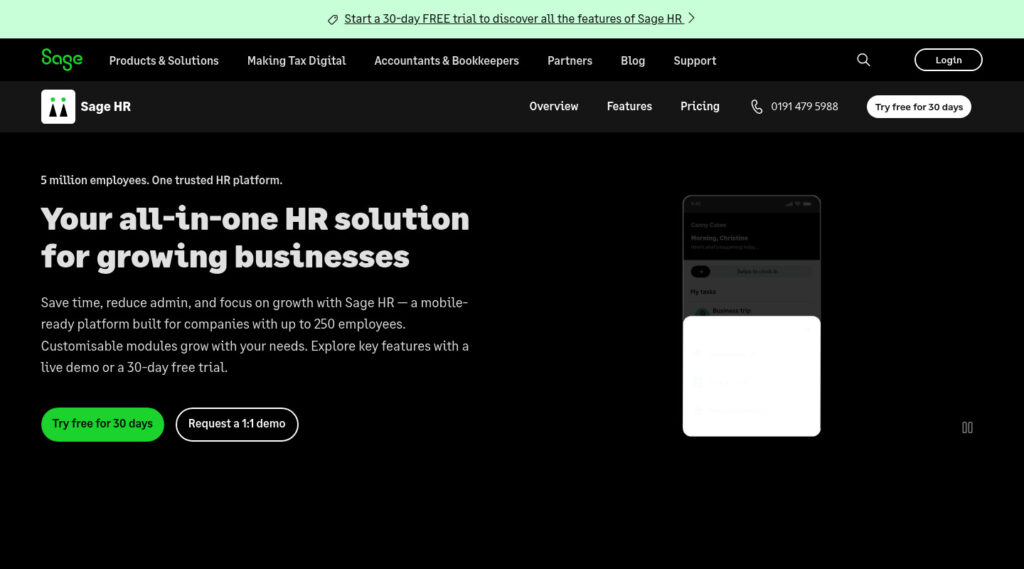
Sage is the name most UK finance teams already trust for payroll, with two HMRC-recognised products: cloud Sage Payroll for smaller employers and desktop Sage 50 Payroll for larger needs, with Sage HR alongside for records, leave and performance. For a business that wants an established, HMRC-recognised payroll engine with HR added on, it’s the obvious shortlist entry.
Pros
- HMRC-recognised UK payroll covering RTI submissions, PAYE, National Insurance and auto-enrolment.
- A trusted, long-established UK vendor most accountants already know.
- Modular Sage HR adds records, leave, performance and scheduling as you need them.
Cons
- Sage HR’s core module is light until you add paid modules, and the engagement and analytics tooling is thinner than the specialist people platforms.
- The value is Sage-ecosystem-tilted, strongest for teams already committed to Sage for finance.
Sage review
Sage’s strength is payroll credibility. If your finance team runs Sage Payroll, Sage 50 or Sage 200, the HMRC side is handled by software built around British tax rules and refreshed every tax year, and adding Sage HR creates a tidy, connected stack where people data and payroll share a backbone.
The honest boundary is scope on the HR side. Core HR stays basic without paid add-ons, the engagement and people-analytics tooling is lighter than the modern platforms, and costs climb once several modules are switched on. For a Sage-committed SME that wants a recognised payroll engine first and HR second, the fit’s strong; for a team that wants culture, analytics and payroll given equal weight, it’s narrower.
Sage customers
Sage serves a very broad UK base of small and mid-sized businesses and the accountants who support them.
Sage pricing
Sage HR starts from around £5.00 per employee per month for its core module, with paid modules on top. Sage Payroll is priced by employee band, and a free trial is available.
How Sage has changed over time
In 2026, Sage HR holds 4.3/5 on G2 across 92 reviews, with ease of use and the mobile app praised and initial setup the common sticking point.
Best for
UK SMEs that want an established, HMRC-recognised payroll name with modular HR alongside it.
3. Employment Hero
 Why we picked Employment Hero
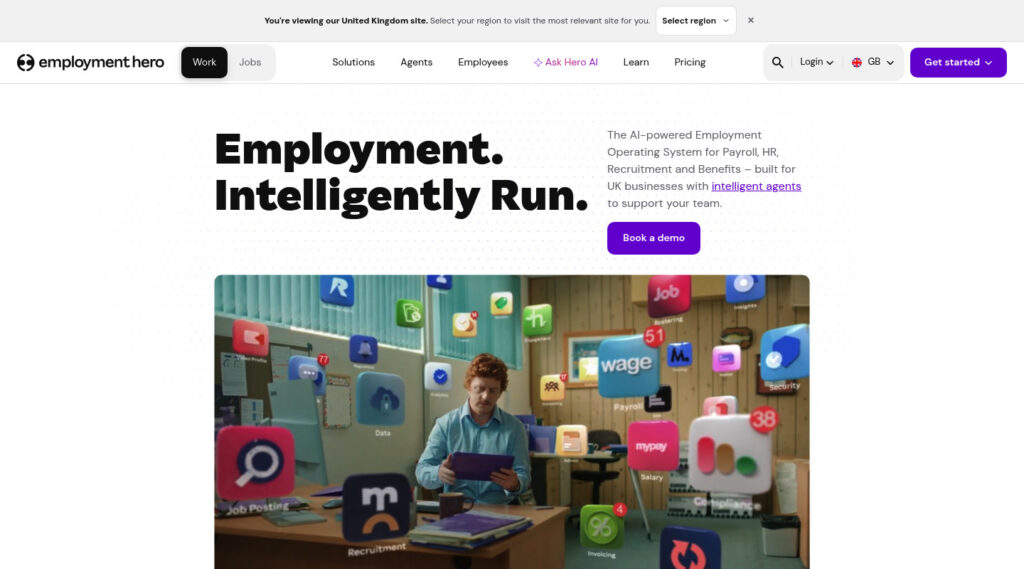
Employment Hero is the natural first comparison for a growing SME, because it bundles native UK payroll and a staff benefits layer into the HR platform instead of charging for them as add-ons. Its payroll engine runs RTI reporting and pension auto-enrolment, so PAYE and National Insurance sit beside onboarding, documents and performance in one subscription.
Pros
- Native UK payroll with RTI reporting and auto-enrolment built in.
- Bundled employee benefits and paperless onboarding with e-signatures.
- Transparent per-employee pricing that suits smaller teams moving off spreadsheets.
Cons
- Broad rather than deep in places, and the reporting suite takes some learning before it gives back what you need.
- Larger mid-market teams with complex analytics or multi-entity structures tend to want more headroom than the SME tiers provide.
Employment Hero review
For a UK business under a few hundred staff that wants a single bill for HR and payroll, Employment Hero is a strong, well-priced starting point. The payroll runs the HMRC essentials, the benefits layer is a genuine differentiator at the SME end, and the onboarding is paperless.
The trade-off is depth as you climb. Breadth over depth means the analytics and configurability can feel tight once a team pushes past the SME band, and businesses with several legal entities tend to want more. For the growing SME it’s aimed at, the all-in-one convenience is the draw.
Employment Hero customers
Employment Hero is adopted across UK and Australian SMEs, weighted towards smaller and growing employers.
Employment Hero pricing
Pricing starts from around £4 per employee per month for the HR Essentials tier, with payroll and benefits on higher plans and a minimum spend on the smallest teams. It’s demo-led.
How Employment Hero has changed over time
In 2026, Employment Hero’s 4,331 G2 reviews (4.4/5) most often praise ease of use and support, with missing-feature notes at the edges as teams scale and ask more of the analytics.
Best for
UK SMEs that want native UK payroll, HR and employee benefits bundled from day one.
4. Access PeopleHR
 Why we picked Access PeopleHR
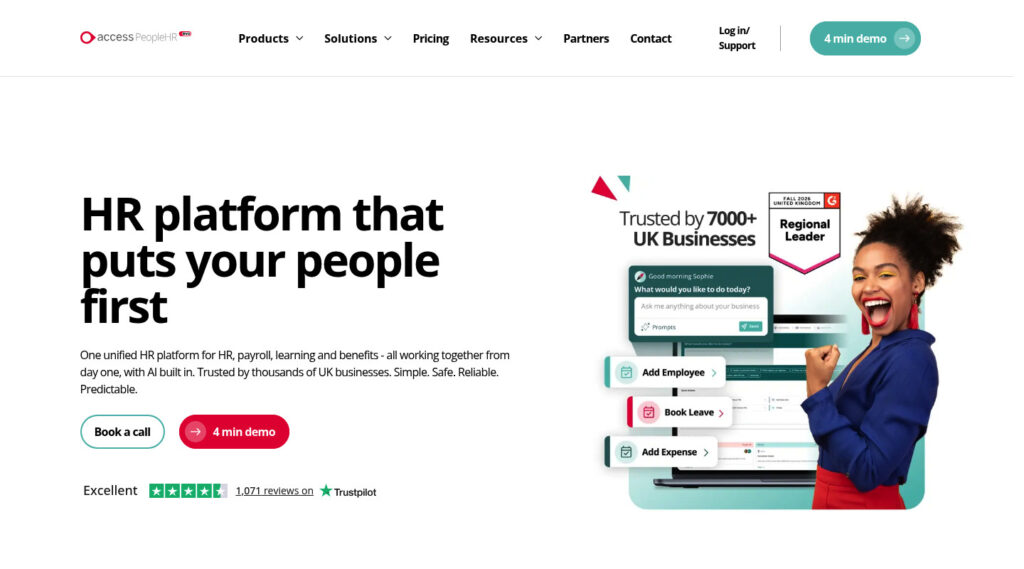
Access PeopleHR brings core HR and UK payroll together from a single, established British software group. Because The Access Group runs UK payroll across its wider portfolio, a growing organisation can keep records, performance and HMRC-recognised payroll inside one vendor relationship rather than wiring an HR tool to a separate payroll provider.
Pros
- Native UK payroll available from the same group that provides the HR software.
- Solid core HR with self-service, applicant tracking and performance for growing teams.
- Part of a broad, established UK HR and payroll portfolio with room to grow.
Cons
- The suite is broad but can feel heavier and more traditional in places than the newest people-first platforms.
- Pricing is quote-based with no public figure, so you’ll need a conversation to size it.
Access PeopleHR review
Access PeopleHR suits a UK business that has outgrown a basic admin tool and wants HR and payroll under one roof without moving to enterprise weight. The HR product covers the system-of-record essentials well, and the Access Group payroll heritage means the HMRC side is handled by software built for British rules.
The documented boundary is experience and scale posture. As part of a large portfolio assembled over time, the UX is more considered-professional than consumer-slick, and buyers sometimes work across several products rather than one unified platform. For an organisation that values a single established UK group across HR and payroll, that breadth is the appeal.
Access PeopleHR customers
Access PeopleHR is used across UK small and mid-sized organisations, part of a portfolio trusted by thousands of UK businesses.
Access PeopleHR pricing
Pricing is quote-based, with no public per-employee figure. Payroll is available from The Access Group portfolio and sized to your requirement. It’s demo-led.
How Access PeopleHR has changed over time
In 2026, UK reviewers rate Access PeopleHR 4/5 on G2 across 486 reviews for its records and self-service, with the note that the broader portfolio rewards a clear implementation plan.
Best for
Growing UK organisations that want core HR and native UK payroll from one established British group.
5. Ciphr
Why we picked Ciphr
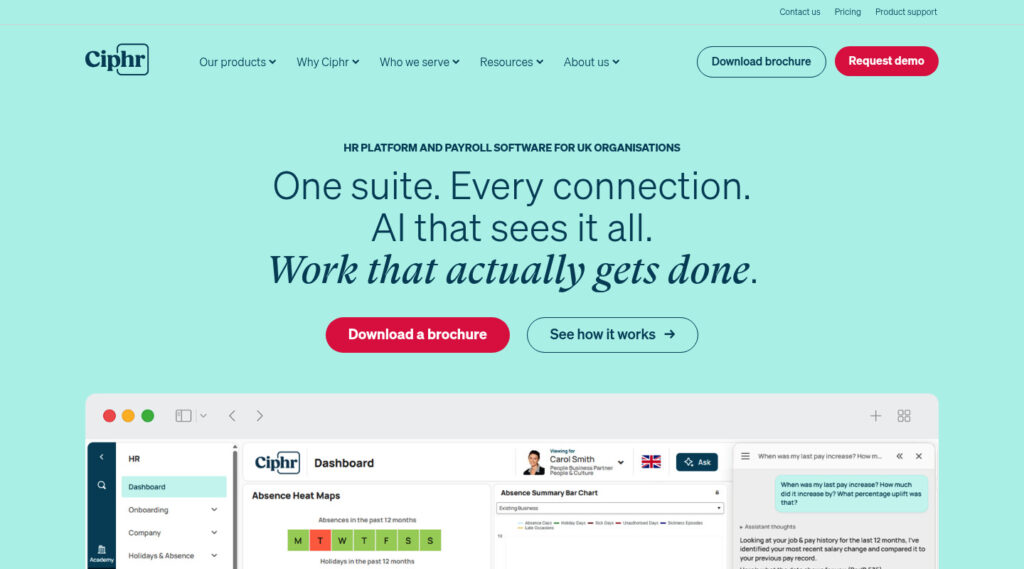
Ciphr is a British HR and payroll specialist built for the larger, more complex end of the market, where compliance depth and configurability matter more than quick setup. Its integrated suite pairs core HR with Ciphr Payroll, so RTI, PAYE, National Insurance and statutory calculations run inside a UK-focused platform designed around UK employment rules rather than retrofitted to them.
Pros
- Integrated Ciphr Payroll with full RTI and statutory handling.
- UK-built for the compliance needs of larger, process-heavy employers.
- Deep configurability for complex organisational structures and multiple sites.
Cons
- Aimed at mid-to-large organisations, so it isn’t the tool a 20-person startup reaches for.
- Implementation and configuration take planning rather than plug-and-play setup.
Ciphr review
For organisations with hundreds or thousands of staff, several sites and a serious compliance burden, Ciphr’s native UK heritage is reassuring. The payroll is built for British rules, the configurability handles awkward organisational structures.
The boundary is who it’s for. The modern, consumer-style experience some teams want isn’t Ciphr’s primary selling point, and the platform rewards a proper implementation rather than a weekend setup. Where UK compliance and scale are the priority over a fast, people-first rollout, it’s a credible native HR and payroll choice.
Ciphr customers
Ciphr serves mid-to-large UK employers, including public-sector and process-heavy organisations that need configurability and compliance depth.
Ciphr pricing
Pricing is by quote, with no public figure. The integrated HR and payroll suite is sized to the organisation, which fits the larger buyers it targets. It’s demo-led.
How Ciphr has changed over time
In 2026, UK reviewers put Ciphr at 3.7/5 on G2 across 6 reviews, praising payroll accuracy and reporting depth while noting it repays a considered implementation.
Best for
Mid-to-large UK employers that need native UK payroll and configurability over quick, consumer-style setup.
6. PayFit
 Why we picked PayFit
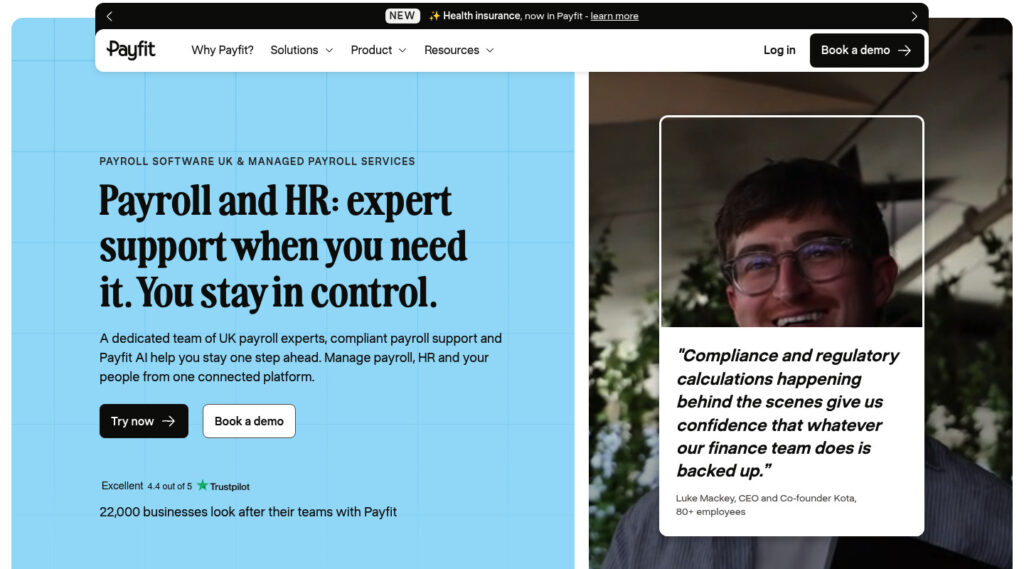
PayFit’s a managed UK payroll and HR service that takes much of the operational load off a lean team. Payroll experts collect and check your data, calculate PAYE and National Insurance, generate payslips and submit RTI to HMRC on your behalf, with leave and absence tracking and an AI payroll and HR companion alongside.
Pros
- Managed UK payroll with RTI submissions to HMRC and auto-enrolment handling.
- Subscription pricing per employee per month with no hidden per-event fees and onboarding included.
- Lighter-touch HR for leave and absence on top of the payroll service.
Cons
- Payroll-led, with lighter strategic HR than a full people platform, so performance, engagement and workforce planning aren’t the focus.
- UK and French in orientation, so it’s less suited to broad multinational operations.
PayFit review
PayFit sits between software and service. Rather than hand you a payroll engine to drive, it runs the pay cycle for you, which suits an SME that wants experts on RTI and National Insurance without hiring a payroll specialist.
The documented boundary is scope. As a payroll-first managed service, it’s lighter on the strategic HR layer, so a business that wants deep performance, engagement and people analytics in one system will weigh that. For UK payroll run as a managed subscription with enough HR to cover leave and absence, it’s a strong option.
PayFit customers
PayFit serves thousands of UK and European SMEs that want payroll managed as a subscription rather than operated in-house.
PayFit pricing
Pricing is a per-employee monthly subscription with onboarding included and no per-event fees, quoted to your headcount rather than published as a figure. It’s demo-led.
How PayFit has changed over time
In 2026, UK SMEs rate PayFit 4/5 on G2 across 24 reviews for taking the payroll burden off small teams, with the consistent caveat that it’s payroll-led and lighter on advanced HR.
Best for
UK SMEs that want HMRC-recognised payroll run for them as a managed subscription, with light HR alongside.
7. BrightPay
Why we picked BrightPay
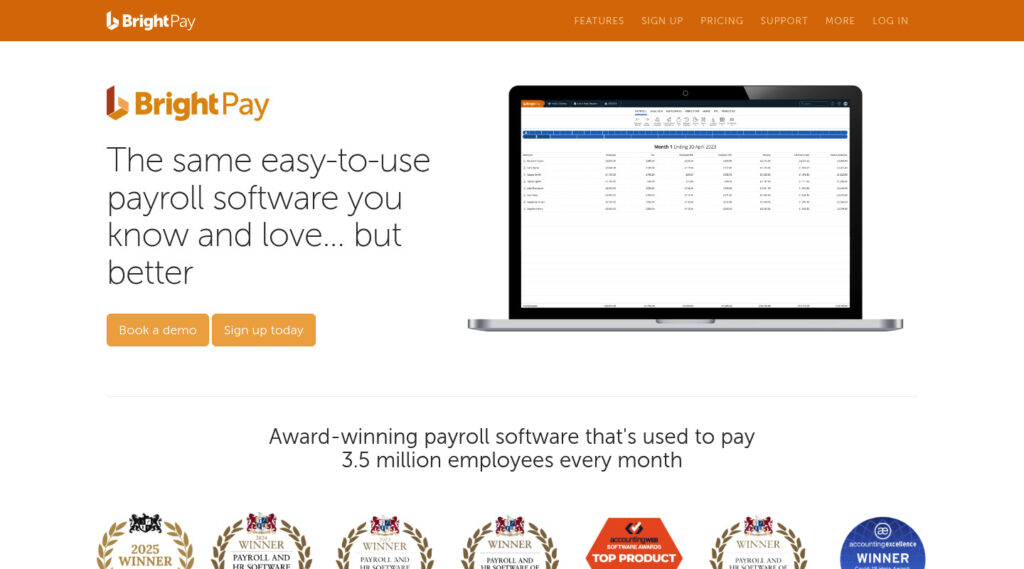
BrightPay is a dedicated UK and Irish payroll product, popular with accountants, bureaus and small employers who want a focused, HMRC-recognised engine rather than a broad platform. It covers RTI, auto-enrolment, payslips and batch or bureau processing, available as desktop software and through BrightPay Cloud.
Pros
- Fully HMRC-recognised UK payroll with RTI and auto-enrolment.
- Strong bureau and batch processing for accountants running many client payrolls.
- Desktop and cloud options, with a free trial to evaluate it.
Cons
- Payroll only: there’s no core HR platform, so records, leave, onboarding and performance live elsewhere.
- An employer that wants HR and payroll in one system will need a separate HR tool beside it.
BrightPay review
BrightPay is the clearest example of why the native-payroll column alone doesn’t tell the whole story. It runs UK payroll the way it should and is well liked by the accountants and bureaus who process payroll at volume, and for a small employer that needs reliable RTI filing and auto-enrolment it does the job at a sensible cost.
Scope is the boundary, and a deliberate one. BrightPay is a payroll engine, not an HRIS, so it holds pay data rather than your people system of record, and the HR side, onboarding, documents, performance and engagement, isn’t part of the product. For a business that wants records and payroll unified, that’s the trade-off; for a payroll-first team or a bureau, the focus is the appeal.
BrightPay customers
BrightPay is a mainstay among UK and Irish accountants, payroll bureaus and small employers who process payroll in volume.
BrightPay pricing
BrightPay is licensed per employer per tax year, scaling by the number of employees and the features used, with a free trial to evaluate it. Its pricing page confirms the product is fully HMRC-recognised but doesn’t set out a full sterling table, so size a licence with the vendor itself.
How BrightPay has changed over time
In 2026, UK payroll teams and accountants rate BrightPay 4.6/5 on G2 across 28 reviews for dependable RTI processing and bureau workflows, with the understood caveat that it’s a payroll product rather than an HR platform.
Best for
Accountants, bureaus and small UK employers that want a focused, HMRC-recognised payroll engine.
8. Moorepay
Why we picked Moorepay
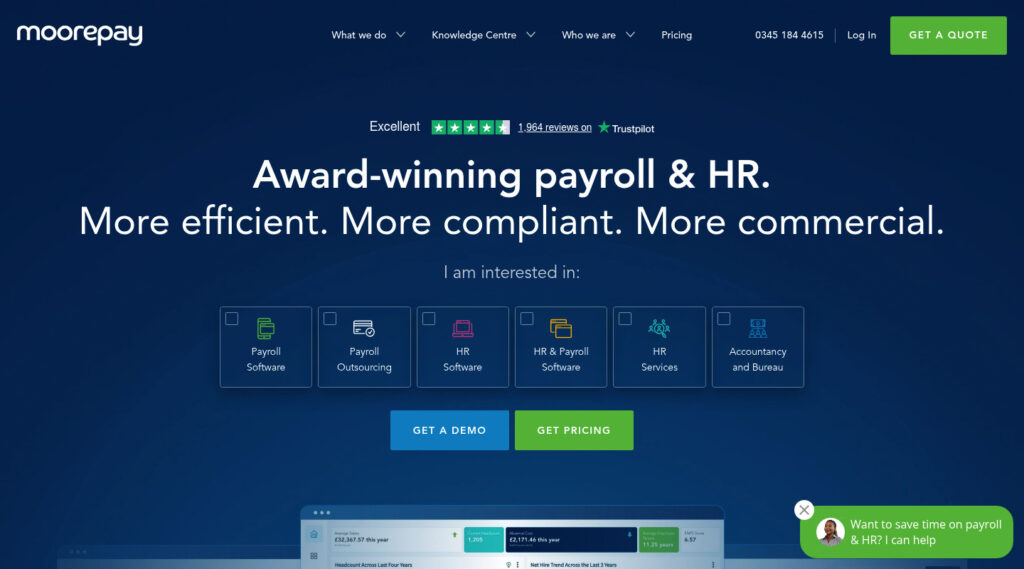
Moorepay is an established UK provider of managed payroll and HR services, combining HMRC-recognised, outsourced payroll with HR and employment-law advisory. For an employer that would rather hand the pay cycle to a bureau than run software in-house, it’s a long-standing option built around RTI compliance.
Pros
- HMRC-recognised managed payroll with RTI compliance, run as an outsourced service.
- HR and employment-law advisory alongside payroll for employers that want guidance.
- A long UK track record with mid-market employers.
Cons
- An outsourced-bureau and advisory model rather than a modern, self-serve people platform.
- Lighter on the culture, engagement and consumer-style experience that the modern platforms lead with.
Moorepay review
Moorepay fits an employer of about 50 to 1,000 staff that wants payroll taken off its plate and backed by employment-law support. The payroll is HMRC-recognised, and the advisory layer is a genuine draw for a business without in-house HR expertise.
The documented boundary is the model itself. This is outsourced payroll with HR advisory, not a modern platform your whole workforce logs into daily, so the employee experience and people-analytics layer isn’t where it competes. For a team that values a managed service and advice over a self-serve system, that’s the point.
Moorepay customers
Moorepay serves UK mid-market employers, from around 50 to 1,000 staff, that want managed payroll and HR advisory.
Moorepay pricing
Pricing is quote-based, arranged through a pricing conversation or a demo rather than published, and sized to the service and headcount. It’s a managed-service engagement rather than a self-serve trial.
How Moorepay has changed over time
In 2026, UK mid-market employers rate Moorepay 4.1/5 on G2 across 39 reviews for dependable managed payroll and advisory support, with the understood trade-off that it’s a bureau service rather than a modern self-serve platform.
Best for
UK mid-market employers that want outsourced, HMRC-recognised managed payroll with HR advisory.
9. BambooHR
Why we picked BambooHR
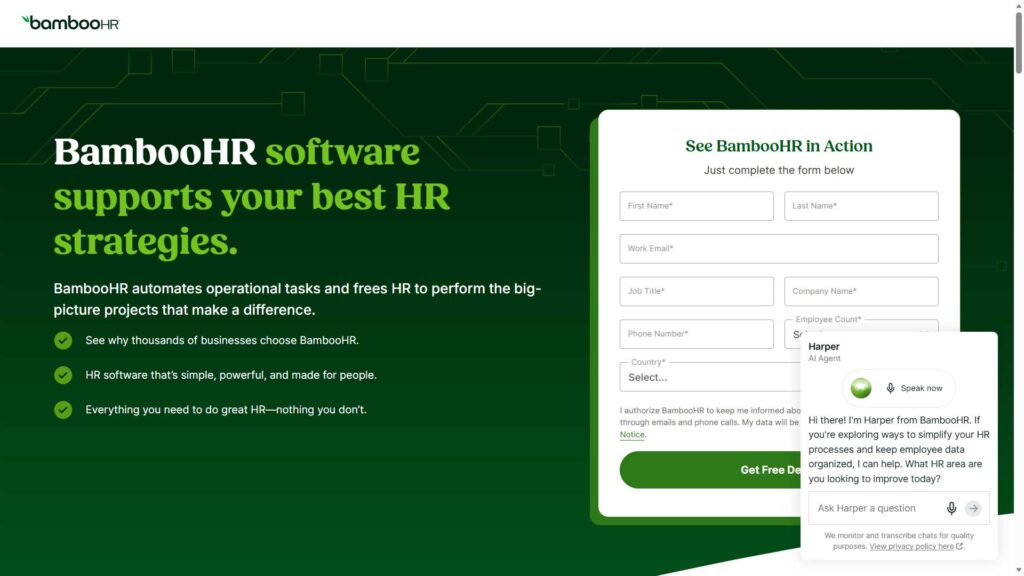
BambooHR is one of the most recognisable HR brands on the market, and the recognition is earned: the core HRIS fundamentals are done well, in a clean interface that employees take to, with strong onboarding, an employee directory, e-signatures and well-regarded People Data analytics. For the UK arm of a US-headquartered group that wants a tidy system of record, it’s an easy platform to live in.
Pros
- Clean, intuitive interface with high employee adoption.
- Strong onboarding and well-regarded People Data analytics.
- A dependable core system of record for records, leave and documents.
Cons
- No native UK or HMRC payroll: PAYE, National Insurance, RTI and auto-enrolment go to a partner or a separate payroll tool.
- Plans are listed in US dollars and UK buyers are quoted, which makes true cost harder to compare at a glance.
BambooHR review
For records and employee experience, BambooHR is excellent. The caveat on a combined HR and payroll search is specific: BambooHR is US-built and doesn’t run native UK payroll, so the HMRC side lives in a partner integration rather than in the product. That’s a legitimate setup, as long as you accept you’re buying an HR system plus a separate UK payroll provider.
Pricing adds a second wrinkle for UK buyers. The published plans are in US dollars, so British teams work from a quote rather than a sterling list price. Limited customisation is the recurring documented caveat for teams that need to stretch the platform, though for a clean core HRIS it remains a dependable choice.
BambooHR customers
BambooHR is used by a very large base of small and mid-sized businesses worldwide, with strong adoption among US-headquartered companies.
BambooHR pricing
BambooHR’s plans are priced per employee per month at Core ($10/mo), Pro ($17/mo), and Elite ($25/mo). For small teams of 25 or fewer employees, a flat monthly rate applies, starting from $250/mo. UK buyers are quoted based on these tiers, and a free trial of the core product is offered. UK payroll is available as an added cost through a partner or separate tool.
How BambooHR has changed over time
In 2026, BambooHR’s 7,164 G2 reviews (4.4/5) still centre on how easy it is to use, with limited customisation the recurring note, and UK buyers continuing to pair it with a separate payroll provider.
Best for
US-headquartered teams that want a clean core HRIS and are content to run UK payroll through a separate partner.
10. Breathe
Why we picked Breathe
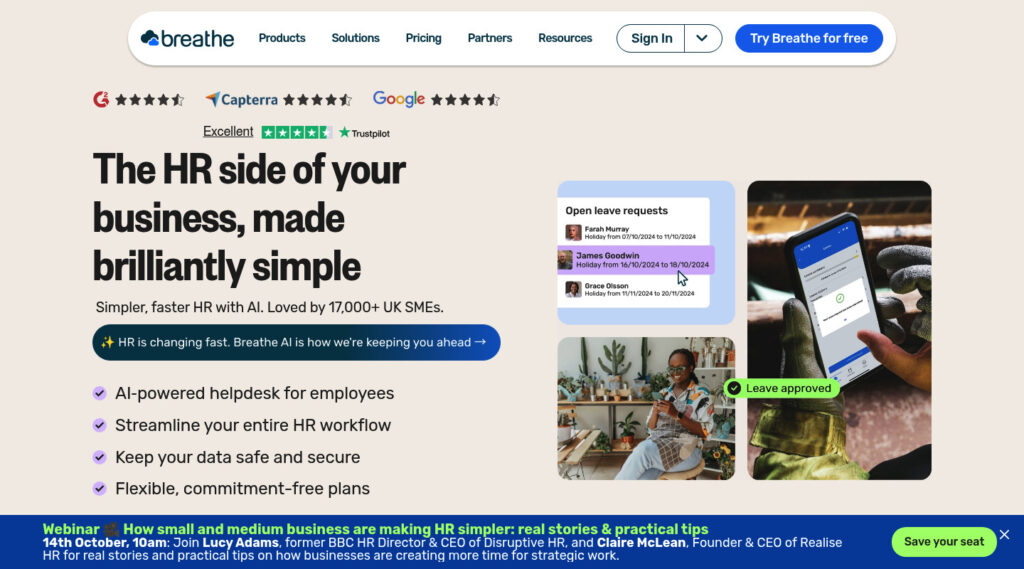
Breathe is a UK-built favourite for small businesses that need the essentials done well: leave and absence management, an employee database, document storage and basic performance, wrapped in an interface most teams pick up without training. Its flat monthly pricing by team-size band means a micro business always knows what it will pay.
Pros
- Simple, with almost no training needed to run it.
- Predictable flat monthly pricing by team-size band, with no per-head surprises.
- Solid leave, absence and records management for small teams.
Cons
- HR-only: Breathe doesn’t include native payroll, so PAYE, National Insurance and auto-enrolment live in a separate payroll product you integrate.
- Built for very small teams, so a fast-growing business tends to meet a ceiling and face a re-platform as it scales.
Breathe review
For simple HR admin at the small end, Breathe is hard to beat on ease, and a non-specialist can run leave, records and documents without a manual.
The boundary is central to a payroll search: Breathe is HR-only and doesn’t run payroll, a point the vendor makes itself. You keep PAYE and auto-enrolment in a separate tool and integrate the two. Built for very small teams, it tends to reach a scale ceiling, so a growing business plans for a re-platform.
Breathe customers
Breathe is used by thousands of small UK businesses that want straightforward HR admin.
Breathe pricing
Breathe uses flat monthly pricing in tiers by team-size band, so a small team pays a predictable monthly fee rather than a per-head rate, with a free trial to start. Confirm the current band figure for your headcount with the vendor.
How Breathe has changed over time
In 2026, Breathe holds 4.4/5 on G2 across 608 reviews as of October 13, 2026, with small UK businesses praising how fast a non-specialist can run it, whilst noting it’s by design light on advanced features and carries no payroll of its own.
Best for
Very small UK teams that want simple, affordable HR admin and will pair it with a separate payroll tool.
How much does UK payroll software cost?
UK payroll pricing comes in three shapes, and knowing which you’re looking at saves a lot of comparison pain. Per-employee monthly subscriptions, used by the modern platforms and managed services, run from £4 to £12 per employee per month depending on the modules switched on. Per-employer annual licences, common with dedicated payroll products such as BrightPay, charge by employer and employee count per tax year rather than per head per month, which can work out cheaper for a stable team. Quote-based pricing, used by HiBob, Access PeopleHR, Ciphr and Moorepay, reflects the modules and scale you need and means a conversation rather than a list price.
Two cost traps are worth naming. A platform with no native UK payroll carries a hidden second line, the separate payroll provider you integrate, so a cheap HR tool plus a payroll tool can cost more than one combined platform once you add both and the time spent reconciling them. Pricing listed in US dollars, as with BambooHR, isn’t a like-for-like UK figure, so budget from a sterling quote rather than a converted headline.
How UK payroll differs across England, Scotland, Wales and Northern Ireland
UK payroll carries a wrinkle most single-country markets avoid: four nations under one tax authority. RTI, National Insurance, pension auto-enrolment and statutory pay run UK-wide, but income tax has diverged since devolution. Scotland has set its own rates and bands since 2017, with more bands than the rest of the UK, so an employee on a Scottish S-prefix tax code takes home a different amount from an identical colleague in England. Wales gained the power in 2019 and has so far matched English rates, and Northern Ireland stays aligned with England.
The first time I processed a pay run with a Scottish employee, this was the detail that mattered: good software applies the correct rates by where each person lives, not where the business is based, and copes when someone relocates across a border mid-year. A platform that treats the UK as a single tax regime will get Scottish take-home pay wrong behind the scenes, the sort of error that surfaces in a complaint rather than an alert. When you shortlist, ask each vendor how it handles S and C tax codes and a mid-year relocation, and treat a vague answer as a red flag.
How to choose the right HR and payroll software for your UK business
The choice comes down to two questions: do you want HR and payroll in one system or two, and how big is the team you’re buying for.
If you want one combined system, prioritise native, HMRC-recognised payroll inside the platform. HiBob leads for an employer that also wants modern HR, analytics and engagement and expects to scale, with Employment Hero and Sage strong for SMEs, and Access PeopleHR and Ciphr suited to larger and more compliance-heavy organisations.
If you’re happy with two systems, a capable HR tool plus a separate payroll provider is a good design, as long as you cost and reconcile both. BambooHR is an excellent core HRIS for a US-headquartered team that runs UK payroll on a separate system, and Breathe suits a very small team that will pair simple HR admin with a payroll tool.
If payroll is the priority and HR is secondary, the specialists earn their place. PayFit runs managed UK payroll as a subscription with light HR, Moorepay runs it as an outsourced bureau with advisory, and BrightPay gives accountants and small employers a focused, HMRC-recognised engine.
Whichever way you lean, keep the HMRC checklist beside every demo and ask the native-versus-integrated question first. It decides more than any feature comparison.
The bottom line on the best HR and payroll software for the UK
The best payroll software UK employers can choose comes down to a single question: does one system hold your people records and run HMRC-recognised payroll, or are you buying two in all but name? For most employers that want the first answer, HiBob is the strongest fit, because Bob runs native UK payroll (RTI submissions, PAYE, National Insurance, auto-enrolment, SSP and P60/P45) inside an all-in-one people platform, keeping pace from growing SME to enterprise, with the engagement and analytics depth to match. Sage and Employment Hero are excellent combined options for SMEs, Access PeopleHR and Ciphr bring native payroll and compliance depth to larger organisations, and PayFit, Moorepay and BrightPay cover the payroll-led end. BambooHR and Breathe are capable HR tools that need a payroll partner beside them. Match the platform to where your headcount is heading, keep the native-HMRC-payroll column in view, and you’ll land on software that still fits after your next hundred hires.